XRP is one of those crypto assets investors keep hearing about whenever cross-border payments, banks, and “real-world utility” come up. But here’s the part most beginners miss: XRP is the digital asset, while Ripple is the company that builds payment technology. So when people say “XRP (Ripple),” they’re usually mixing two connected things—a coin (XRP) and a payments network/business (Ripple) that helps move money globally. If you’re an investor, this difference matters because your investment is typically in XRP, not Ripple’s private company shares.
XRP runs on the XRP Ledger (XRPL), which is a public blockchain-style network designed to move value fast, with low fees, and without the energy-heavy mining model used by Bitcoin. The XRPL uses a consensus protocol (not Proof of Work) to validate transactions efficiently, which is part of why it’s known for speed and low cost.
What Is XRP (Ripple)?
At its core, XRP was created to make it easier to move money across borders without waiting days or paying huge fees. If you’ve ever sent international money through banks, you know the feeling: the transfer takes time, rates aren’t always great, and fees can stack up in ways you didn’t expect. XRP exists as a “bridge asset”—something that can temporarily represent value during a transfer between two currencies.
A helpful investor-friendly way to think about XRP is like this:
- Money wants to move instantly
- Bank systems don’t always move instantly
- XRP tries to fill the gap by settling value quickly
And speed matters here. On the XRP Ledger, transactions are commonly reported to finalize in around 3–5 seconds, and the network is often cited as being able to handle around 1,500 transactions per second (TPS).
XRP vs Ripple: What’s the Real Difference?
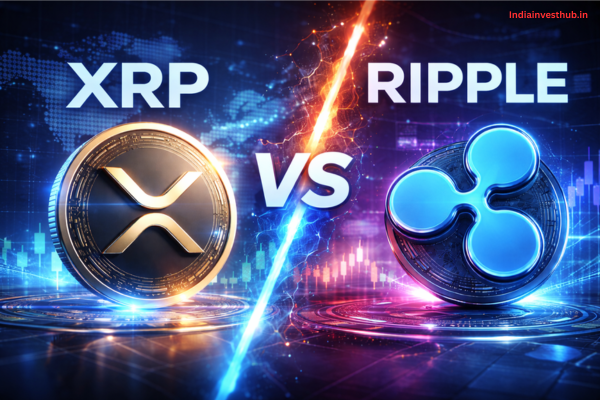
This is where many investors get confused, so let’s make it crystal clear:
- XRP = the cryptocurrency (digital asset)
- Ripple = the company building payment products
- XRPL (XRP Ledger) = the network where XRP lives and moves
Ripple can build solutions that may use XRP in certain cases, but XRP can exist and be traded independently of Ripple as a business.
In the Ripple ecosystem, XRP is often positioned as a liquidity tool—meaning it can help institutions avoid parking large amounts of money in different countries just to enable transfers (this is called pre-funding). Investopedia describes XRP’s role as a bridge currency and highlights its use in providing on-demand liquidity for cross-currency transfers.
How Does XRP Work?
XRP works through the XRP Ledger (XRPL), where transactions are confirmed using a consensus system rather than mining. This is a big investor detail because it affects:
- transaction speed
- transaction fees
- energy consumption
- scalability
The XRPL consensus algorithm is designed as an alternative to proof-of-work systems and doesn’t rely on energy-intensive mining.
Unlike Bitcoin where miners compete to add blocks, XRPL transactions are validated by a network of validators that come to agreement on transaction order and legitimacy.
What Is RippleNet and How It Uses XRP for Payments?
RippleNet is Ripple’s payment network for financial institutions. It’s basically the “business-facing” side—tools and systems that help institutions send money across borders more efficiently.
One of Ripple’s services is On-Demand Liquidity (ODL) (previously known as xRapid), where XRP can be used as a bridge currency so institutions don’t need to hold pre-funded accounts in destination currencies. AWS describes xRapid/ODL as using XRP for on-demand liquidity, aiming to lower capital requirements while enabling fast payments—especially in emerging markets.
Important investor note: RippleNet does not always require XRP, but XRP is one of the tools within Ripple’s broader system when regulations and business needs allow.
XRP Ledger (XRPL): Key Features and Technology Behind XRP
The XRPL is the backbone of XRP. For investors, the XRPL matters because it’s where the real “utility story” comes from.
Key XRPL points (investor-focused):
1) Fast settlement
Many references cite 3–5 seconds finality for XRP Ledger transactions.
2) Low transaction cost
XRPL’s official documentation states the minimum transaction cost for a standard transaction is 0.00001 XRP (10 drops), with dynamic changes during high load.
3) Scalability
Reports often cite ~1,500 TPS, which is far higher than Bitcoin’s commonly referenced throughput.
4) No mining
XRPL doesn’t use proof-of-work mining, which supports the “efficient payments layer” narrative many XRP investors focus on.
XRP Transaction Speed, Fees, and Scalability Compared to Bitcoin:
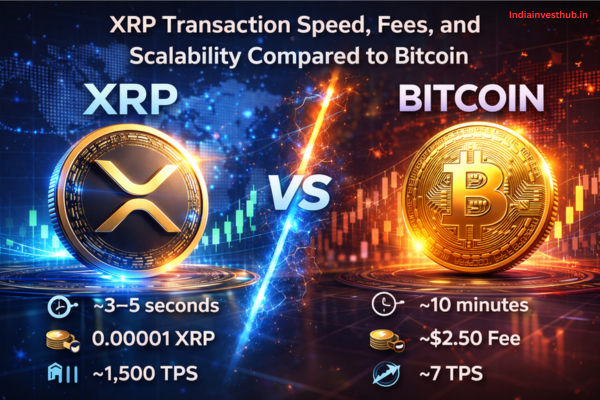
Investors often compare XRP and Bitcoin because both are widely known, but they’re designed for different goals.
XRP (XRPL)
- Finality: ~3–5 seconds
- Throughput: ~1,500 TPS
- Minimum fee: 0.00001 XRP
Bitcoin (general comparison)
Bitcoin is optimized for security and decentralization, not speed. Many educational comparisons cite Bitcoin at roughly 7 TPS, which highlights why XRP is often pitched as a payments-focused asset.
From an investing angle, this comparison matters because faster settlement + low fees can support real usage—especially for money transfers, remittances, and institutional payments.
Top Real-World Uses of XRP (Cross-Border Payments & Banking):
If you’re an investor, the most important question is simple:
Does XRP have a real use case that can drive demand over time?
Here are the main “real-world use” narratives investors track:
1) Cross-border payments
Ripple’s products target the pain points of international transfers: high fees, slow settlement, and the need to pre-fund accounts. XRP can be used as a bridge asset for liquidity in certain transfer flows.
2) Liquidity for institutions
The ability to move value without holding multiple currency accounts is the big selling point. This is the story behind ODL.
3) Fast settlement rails
Even beyond institutions, the XRPL’s speed and cost profile make it attractive for transferring value quickly.
The investor takeaway: XRP’s strongest “why” is payments utility, not being a meme coin or purely speculative asset.
XRP Price History: All-Time High, Major Drops, and Recovery
Every serious investor should understand XRP’s history because it tells you what the market is capable of doing—both up and down.
XRP All-Time High (ATH)
Many platforms report XRP’s all-time high as $3.84 in early January 2018. Kraken references this directly in its XRP historical summary.
Coinbase also reports XRP’s all-time high around that period (shown in INR on its page).
Major drops & long recovery periods
After 2018, XRP experienced major drawdowns (like most crypto assets). XRP also went through heavy uncertainty during periods of regulatory pressure in the U.S., which affected exchange listings and investor sentiment.
The investor lesson: XRP has proven it can move explosively in bull cycles, but it also carries big volatility risk.
Is XRP a Good Investment? Risks, Rewards, and Legal Issues
This is the part where smart investors slow down and think in probability—not emotion.
Potential rewards investors look at
- Utility narrative (payments + liquidity)
- Fast and low-cost blockchain design
- Retail + institutional interest during bull markets
- Possibility of increased adoption if cross-border payment demand grows
Key risks investors must respect
1) Regulatory uncertainty
XRP has faced regulatory challenges in the U.S. over whether it should be treated as a security in certain contexts. Wikipedia summarizes the 2023 court decision stating XRP itself is not a security, while noting the “manner in which it is sold” can matter legally.
2) Competition
Cross-border payments is a massive market, and XRP isn’t alone. Other crypto networks, stablecoins, and even traditional systems are improving.
3) Market volatility
Even the best projects can fall hard in bear markets.
Investor mindset tip: Don’t treat XRP like a guaranteed “lottery ticket.” Treat it like a high-risk, high-upside asset that needs position sizing and risk control.
XRP Future Price Potential (2025–2030): Predictions and Key Factors
Let’s be real: nobody can promise XRP’s exact future price.
But investors can still estimate what would need to happen for XRP to rise strongly again.
Here are the biggest factors that can influence XRP future price potential from 2025–2030:
1) Broader crypto market cycles
When Bitcoin and overall crypto sentiment is bullish, high-liquidity assets like XRP often benefit.
2) Payments adoption and liquidity demand
If XRP is used more in real settlement flows, demand could grow from actual utility (not just speculation). The strongest “utility narrative” is tied to on-demand liquidity and cross-border transfers.
3) Network performance fundamentals
Speed + low fees remain a key pitch for XRP.
4) Regulation clarity
More legal certainty typically improves investor confidence and exchange access.
5) Supply and market dynamics
XRP has a maximum supply often cited as 100 billion tokens, which impacts scarcity and valuation models.
Investor-friendly reality check:
XRP doesn’t need to “replace the entire banking system” to perform well—it just needs a meaningful slice of real usage + strong market demand during cycles.
FAQs – XRP
Q1: Is XRP the same as Ripple?
👉No. XRP is the coin, Ripple is the company.
Q2: What makes XRP fast?
👉The XRP Ledger uses a consensus protocol instead of mining, enabling fast finality.
Q3: How fast are XRP transactions?
👉Many sources report 3–5 seconds finality and about 1,500 TPS capacity.
Q4: Are XRP fees expensive?
👉XRPL’s official docs list a minimum transaction cost of 0.00001 XRP for a standard transaction.
Q5: What was XRP’s highest price ever?
👉Many exchanges and trackers report around $3.84 in early January 2018.
Conclusion: Should Investors Pay Attention to XRP?
XRP remains one of the most talked-about crypto assets because it sits at the intersection of real-world payments and market speculation, and the XRP Ledger’s speed, low transaction costs, and scalability give it a technical edge for transfers and settlement. At the same time, XRP’s long-term success depends on things investors should track closely—real adoption in payments, overall crypto market cycles, and regulatory clarity—because those factors can shape whether XRP becomes a consistent utility-driven asset or stays mostly a cycle-driven trade.
So, are you investing in XRP for the long-term utility story or for the next big market cycle?