
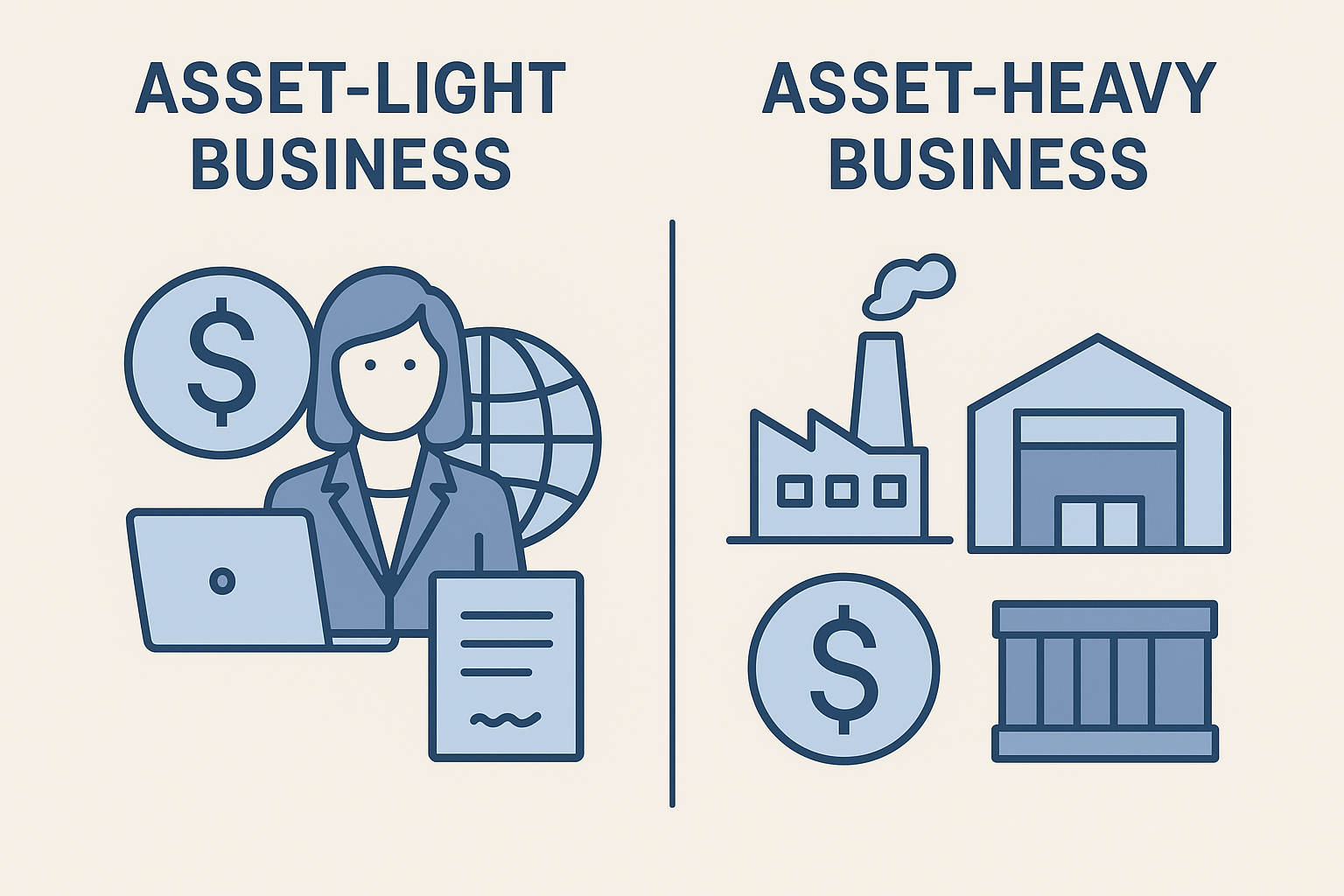
Ravi, a young entrepreneur in Coimbatore, once stayed at a grand hotel in Chennai, part of a famous chain. As he walked through the lobby, he admired the marble floors, the plush carpets, the central courtyard and the heavy doors. Yet, on his next trip, he stayed in a cozy homestay run by a local family. The homestay had no grand infrastructure, few staff, and minimal fixed assets — yet it felt more personalized, nimble, and cost-friendly. Ravi wondered: which model is more sustainable? Which scales better? This contrast is a microcosm of Asset-Light Business and Asset-Heavy Business in real life.
When readers search “What Is the Difference Between Asset-Light Business and Asset-Heavy Business,” they are often trying to understand which model fits their venture or investment horizon. In this article, we will guide you through definitions, comparisons, pros & cons, and help you decide which model might suit you best.
1) What Is an Asset-Light Business Model?
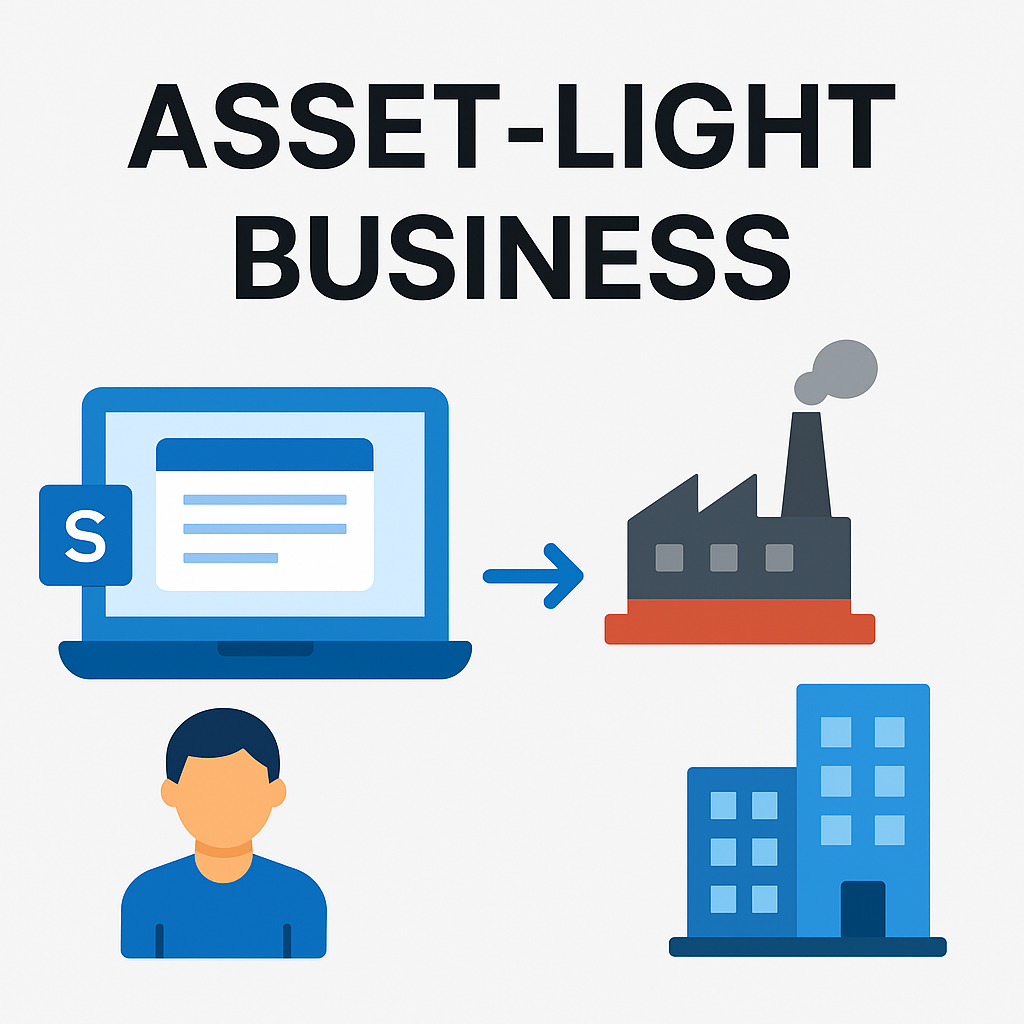
An asset-light business is one where the company owns relatively fewer physical assets. Instead of owning factories, fleets, or real estate, it focuses on capabilities like technology, brand, marketing, platform, or partnerships. The core assets are often intangible (software, network, intellectual property) and the company relies on outsourcing, alliances, or leasing for physical needs.
- For instance, Uber doesn’t own (most of) the cars; it provides the platform that connects drivers and riders.
- Airbnb doesn’t own real estate; it’s a marketplace for hosts and guests.
- Many e-commerce marketplaces, food-delivery platforms, and SaaS firms employ this model.
Because of low capital intensity, asset-light models allow faster scaling, flexibility, and lower fixed cost burdens. A survey by EY found that companies which adopt asset-light strategies often deliver higher total shareholder returns compared to their peers.
Pros:
- Lower capital requirement — You don’t need huge upfront investments.
- Faster growth & scalability — Enter new markets by partnering rather than building.
- Flexibility & agility — Easier to pivot, adjust operations.
- Better capital efficiency — More return per unit of asset deployed.
- Reduced depreciation risk — Less worry about outdated equipment or obsolescence.
Cons:
- Dependence on partners/vendors — Quality, reliability, and consistency can suffer.
- Less operational control — Harder to enforce standards end-to-end.
- Margin squeeze — If partner margins rise or costs shift, your margins may erode.
- Brand or reputational risk — Failures in partner operations reflect back on you.
- Scaling limitations in certain sectors — Some industries demand high fixed-asset investments.
2) What Is an Asset-Heavy Business Model?
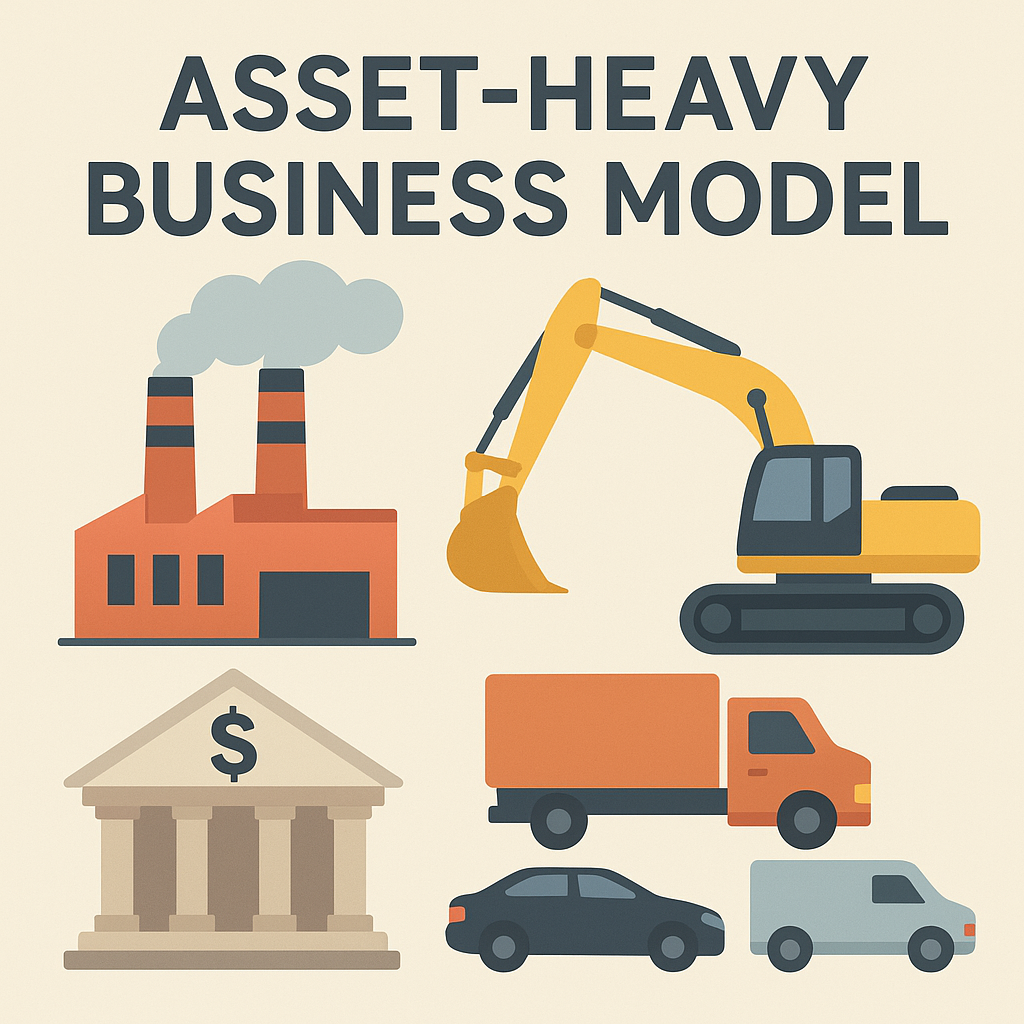
An asset-heavy business is characterized by owning and managing significant physical assets — factories, machinery, infrastructure, real estate, large fleets, etc. These are core to operations, and the business bears the capital expenditure (CapEx), maintenance, depreciation, and related risks.
- Think of a steel plant owning heavy machinery and facilities.
- A hotel chain owning the buildings, land, and furnishings.
- Airlines owning aircraft, maintenance hangars, etc.
Such companies have high fixed costs, strong leverage on scale, but also significant exposure to asset depreciation and utilization risk.
In some industries, especially manufacturing, infrastructure, and energy, a heavy-asset base is often unavoidable. The tradeoff is greater control over operations and quality, but also more capital
Pros:
- Greater control — You own the processes, assets, and standards.
- Cost advantages at scale — Once capacity is filled, marginal cost can be low.
- Barrier to entry — High capital barrier deters new entrants.
- Valuation via assets — The physical assets carry intrinsic value (land, plants, etc.).
- Stable revenues (if demand is steady) — Predictable operations if utilization is high.
Cons:
- High capital lock-in & depreciation — Capital is tied up and exposed to obsolescence.
- Infexibility — Hard to pivot, adapt or scale down in downturns.
- High fixed costs — Must maintain utilization to cover overheads.
- Risk in downturns — Underused assets become a liability.
- Slower growth — Entering new geographies or scaling is costly and time-consuming.
Key Differences Between Asset-Light and Asset-Heavy Businesses
| Feature | Asset-Light Business | Asset-Heavy Business |
|---|---|---|
| Asset Ownership | Minimal physical ownership, reliance on partnerships, leasing, outsourcing | High ownership — owns factories, equipment, real estate |
| Capital Requirement | Lower upfront investment | High capital investment |
| Scalability & Flexibility | Easier to scale, adapt, pivot | Scaling is slower; difficult to adapt to changes |
| Risk Profile | Lower risk tied to asset depreciation, lower fixed costs | Higher risk, especially if assets are underutilized or obsolete |
| Margin Behavior | More variable costs, margins can be more stable or volatile depending on contracts | High fixed cost base, margins sensitive to volume and utilization |
| Control over operations | Less control (outsourced partners) | More direct control over every part of the operation |
| Return on Assets (ROA) | Usually higher (less capital base) | Lower, unless the asset is highly efficient and fully utilized |
A study of 2,687 large companies across sectors showed that asset-light firms, on average, achieved higher returns on operational assets than their heavier counterparts.
Which Model Is Right for You?
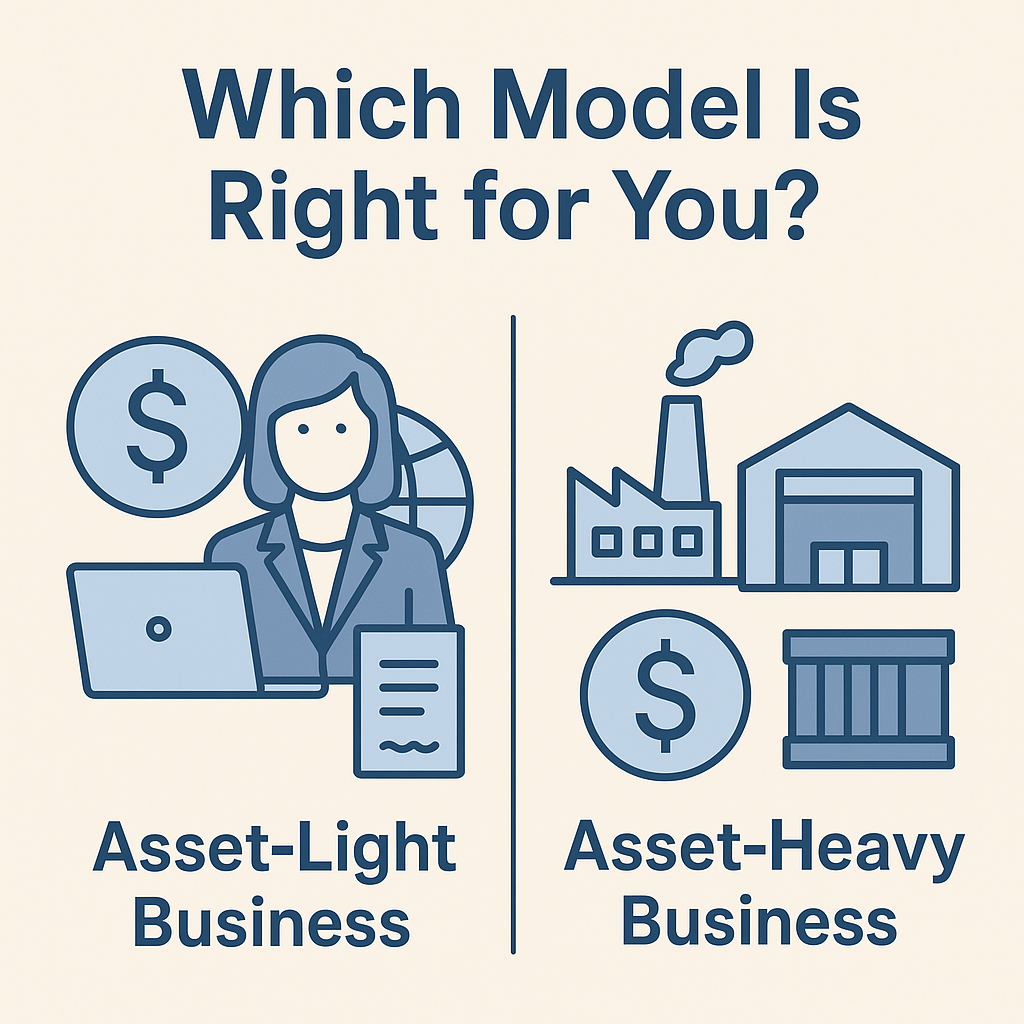
When you, as a reader wanting to grasp “Asset-Light Business and Asset-Heavy Business,” are evaluating which model to adopt (or invest in), consider:
- Industry context: Some sectors demand physical assets (e.g. steel, energy), others don’t (e.g. software, platforms).
- Capital availability: Can you raise or sustain high CapEx?
- Growth ambitions: Do you plan fast expansion into multiple geographies?
- Desired control vs flexibility: Do you prefer full control or partner leverage?
- Risk appetite: Are you comfortable bearing depreciation and utilization risks?
- Hybrid possibilities: Many modern firms mix both — owning core assets while outsourcing non-core.
FAQs – Asset-Light Business vs Asset-Heavy Business
Q1: Can a company switch from heavy to light?
👉Yes — many firms spin off their asset base into separate funds or partnerships, retaining operational control.
Q2: Do asset-light companies always outperform?
👉Not always, but in EY’s research, asset-light firms outperformed others by ~4 percentage points in total shareholder return over 5 years.
Q3: Are there sectors where heavy is unavoidable?
👉Yes — heavy manufacturing, energy, utilities, airports often require large fixed assets.
Q4: What hybrid models exist?
👉Some companies keep critical assets in-house and outsource peripheral ones. Others use joint ventures, leasing, or franchise models.
Q5: Which model do investors prefer?
👉Many venture capitalists and private equity firms prefer asset-light models due to lower capital requirement and higher scalability.
Conclusion:
So, Which Business Model Should You Choose?
- If you prioritize scalability, capital efficiency, and agility, lean asset-light.
- If you need tight control, competitive barriers, and have deep capital, consider asset-heavy.
- In many cases, a hybrid approach – owning critical assets and outsourcing others – offers the best balance.
As you reflect, ask: in my industry, with my capital, and growth vision — which model gives me more upside with manageable risk?


