
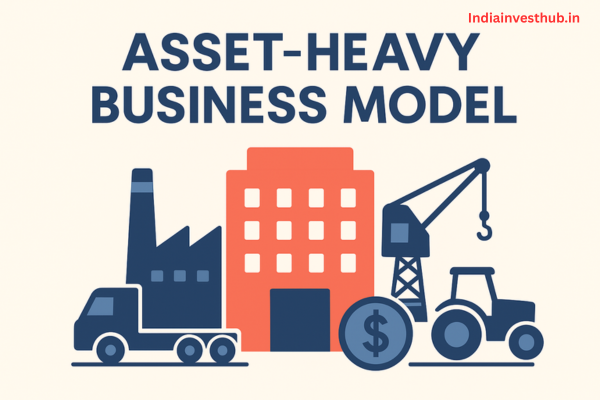
Ravi once dreamed of building a transportation empire in his hometown. With a small loan, he purchased buses, trucks, and built a depot. Every morning he watched those vehicles roll out under his brand name — tangible proof of his dream. But as maintenance bills soared and assets aged, Ravi began to question: is owning every bus really necessary to stay ahead? Welcome to the world of the Asset-Heavy Business Model, where companies carry the weight and control of owning major physical assets.
At Indiainvesthub, we often encounter ambitious entrepreneurs like Ravi, eager to understand whether an asset-heavy path will help or hinder growth. In this article, we’ll guide you — the curious reader — through what an Asset-Heavy Business Model really means, its features, pros and cons, comparisons with lighter alternatives, and how you can decide if it’s right for your venture.
Introduction to the Asset-Heavy Business Model:
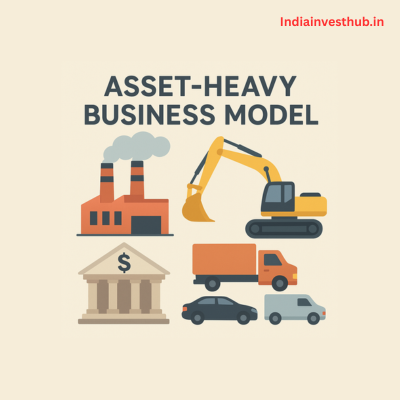
The Asset-Heavy Business Model refers to a structure in which a company invests heavily in physical assets — machinery, real estate, infrastructure, fleets, plants — which are central to its operations. Ownership and control of these assets give the firm direct command over quality, capacity, and usage. But with that power comes large capital requirements, depreciation, and risk.
Key Characteristics:
Some defining traits of an asset-heavy model include:
- High capital expenditure (CapEx): A substantial share of budget is devoted to acquiring and maintaining assets.
- Depreciation & maintenance cost burden: The assets lose value over time, and constant upkeep is required.
- Lower operational flexibility: Scaling up or down is harder, because assets are fixed and durable.
- Control over the value chain: Because you own core productive assets, you control inputs, quality, and scheduling.
- Barrier to entry: New entrants find it difficult to match the scale and capital base.
Examples:
- Railway companies owning tracks and rolling stock
- Oil & gas firms with drilling rigs, refineries, pipelines
- Automobile manufacturers with factories, presses, tooling
- Logistics firms owning warehouses and fleets
- Subscription vehicle companies that own their fleet (as noted in the auto subscription domain)
- In India, the shared-mobility firm Yulu has taken the asset-heavy route, investing in its vehicles and infrastructure; in FY24 it reported ₹123 crore revenue and claims to be EBITDA positive among shared mobility players.
Advantages:
- Full control & quality assurance: You command the supply chain and service delivery.
- Higher margins (if utilization is strong): When assets are well-used, the incremental cost is lower, increasing profitability.
- Competitive moats: Entrants find it hard to replicate your asset base.
- Operational resilience: Less dependence on external providers or partners.
Disadvantages:
- Massive capital intensity: You lock up funds in assets, with slow liquidity.
- Depreciation & obsolescence risk: Assets lose value, especially in changing technology or market conditions.
- Lower flexibility: Adjusting capacity or pivoting is costly and slow.
- Higher fixed costs: You must cover these costs even in downturns.
Difference Between Asset-Light Business and Asset-Heavy Business
Asset-Heavy vs Asset-Light — Comparison Table
Features | Asset-Heavy Model | Asset-Light Model |
|---|---|---|
Image |  |  |
Capital requirement | Very high | Low to moderate |
Flexibility | Low | High |
Control over operations | High | Moderate / outsourced |
Risk exposure (assets) | High | Lower |
Scalability | Slower | Faster |
Profit volatility | Higher (more fixed costs) | Lower |
Barrier to entry | High | Lower |
Asset-Light Business Model
Financial Implications of an Asset-Heavy Model:
Asset-heavy businesses often have a wider gap between net income and free cash flow — because depreciation, maintenance, and capital reinvestment eat into cash.
Also, valuation multiples tend to be more conservative. For instance, in asset-heavy sectors (manufacturing, oil & gas), EBITDA multiples often range from 3× to 5× in smaller deals; larger asset-intensive firms might command 7×–11× depending on subsector.
Moreover, when compared with asset-light peers, research from BCG shows that more asset-light companies, on average across 2,687 firms, delivered higher returns on assets than their more asset-intensive counterparts.
Strategic Management:
To succeed with an asset-heavy model, companies must:
- Optimize utilization — idle assets are value killers.
- Plan lifecycle & replacement — upgrade before obsolescence.
- Hedge risks — diversify asset types, geographic locations, or provide fall-back options.
- Leverage financing models — debt, leasing, sale-and-leaseback, or partial outsourcing of noncore assets.
- Monitor market trends — be ready to shift toward hybrid or lighter models if conditions demand.
Emerging Trends:
- Asset divestiture into funds / REITs: Some asset-heavy firms spin off assets into funds or real-estate investment trusts to free capital while retaining operational ties.
- Hybrid models: Firms adopt a mix of owned assets and leased or outsourced ones (the “asset-right” idea) especially in hospitality and infrastructure sectors.
- Transition pressures: Many companies are shifting toward lighter models — EY found that over the past five years, asset-light firms outperformed peers by ~4 percentage points in total shareholder return.
- Strategic selective heaviness: Even digital platform businesses sometimes selectively invest in core assets when control and availability matter (e.g., micromobility, last-mile logistics).
FAQs — Asset-Heavy Business Model
Q1: Is asset-heavy always better for control?
👉Yes, owning your assets gives you greater control, but that may come at the cost of flexibility and capital strain.
Q2: Can an asset-heavy business become asset-light later?
👉Certainly. Firms often divest, lease, or spin off assets to lighten their balance sheet over time.
Q3: In which industries is asset-heavy more viable?
👉Industries like utilities, infrastructure, energy, manufacturing, transportation — sectors where scale and fixed assets are foundational.
Q4: How do investors value asset-heavy companies?
👉They discount for capital reinvestment needs, depreciation, and risk, often using conservative multiples or asset-based valuation.
Conclusion: Is the Asset-Heavy Model Still Relevant?
Asset-Heavy Business Model is not a relic — it remains relevant, especially in capital-intensive sectors where control, scale, and reliability matter. But it’s no longer a simple “default” choice. Many firms now think in terms of asset-right or hybrid models.
Are you ready to test whether the asset-heavy path will strengthen your competitive edge or become a financial burden?


