Solana (SOL) has emerged as one of the most talked-about blockchain projects in the cryptocurrency space, known for its speed, scalability, and low transaction costs. Designed to support large-scale decentralized applications, Solana aims to solve some of the biggest challenges faced by earlier blockchains, including slow processing times and high fees. By combining innovative technologies like Proof of History with Proof of Stake, Solana can process thousands of transactions per second while keeping costs minimal.
For investors and developers alike, Solana represents more than just another digital currency. The SOL token plays a vital role in powering transactions, securing the network through staking, and supporting a rapidly growing ecosystem of DeFi platforms, NFT marketplaces, gaming projects, and Web3 applications. Its developer-friendly environment has attracted significant attention, leading to fast ecosystem expansion and increasing real-world use cases.
However, like any crypto project, Solana also faces challenges, including network reliability concerns and strong competition from other blockchains. In this guide, we’ll explore what Solana (SOL) is, how it’s used, the key benefits it offers, and what the future outlook may hold—helping you decide whether SOL fits your investment strategy and long-term goals.
Table of Contents
What Is Solana (SOL)?
Solana is a high-performance blockchain designed to support decentralized applications (dApps), DeFi protocols, NFTs, and Web3 platforms at scale. Its native cryptocurrency, SOL, is used to pay transaction fees, secure the network through staking, and participate in governance and ecosystem activity.
Unlike many early blockchains that struggled with congestion and high fees, Solana was built with scalability in mind from day one. According to Solana Labs, the network can theoretically handle over 65,000 transactions per second (TPS) under optimal conditions — far exceeding most first-generation blockchains (Source: Solana Docs).
For investors, SOL represents exposure not just to a coin, but to an entire high-throughput blockchain ecosystem.
How Solana Works — Proof of History and High-Speed Blockchain Technology:
Solana’s biggest technical innovation is Proof of History (PoH) — a cryptographic clock that timestamps transactions before they are processed. This allows the network to agree on transaction order without waiting for traditional block confirmations.
Solana combines Proof of History with Proof of Stake, enabling:
- Faster consensus
- Parallel transaction processing
- Lower latency
This design reduces bottlenecks that slow down other networks. According to academic and industry benchmarks, Solana consistently processes thousands of real transactions per second in live environments, even during high demand (Source: Solana Foundation, CoinMetrics).
For investors, this matters because scalability is often the difference between a blockchain that stays niche and one that supports mainstream adoption.
Key Uses of SOL Token in the Solana Ecosystem:
SOL plays a central role across the Solana ecosystem:
- Paying transaction and smart-contract fees
- Staking to secure the network
- Governance participation (directly or indirectly)
- Liquidity provision in DeFi protocols
As ecosystem usage increases, demand for SOL tends to rise alongside network activity. This utility-driven demand is one reason investors view SOL as more than a speculative asset.
Solana’s Transaction Speed and Low Fees — Why It Attracts Developers:
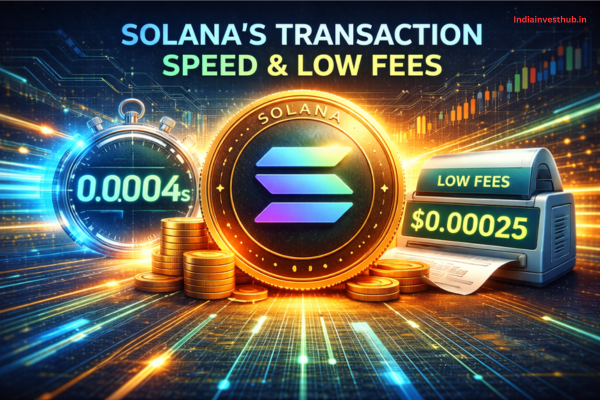
One of Solana’s strongest advantages is cost efficiency. While transaction fees on Ethereum have historically spiked during periods of congestion, Solana transactions typically cost fractions of a cent, even during peak usage.
Low fees and high throughput have attracted developers building:
- Decentralized exchanges
- NFT marketplaces
- Gaming platforms
- Payment applications
By 2025, Solana hosted thousands of active developers, ranking among the top ecosystems globally (Source: Electric Capital Developer Report).
For investors, developer activity is a key indicator of long-term network health.
Benefits of Investing in Solana (SOL):
Solana offers several advantages for investors:
- Exposure to a high-growth blockchain ecosystem
- Strong developer adoption
- Low transaction costs supporting real-world use
- Staking rewards for passive income
- Competitive positioning against legacy blockchains
SOL also benefits from being one of the few large-cap cryptocurrencies with a clear focus on performance at scale — a feature increasingly important as Web3 applications grow.
Solana in DeFi, NFTs, and Web3 Applications:
Solana has become a major hub for DeFi and NFTs. At its peak, Solana’s DeFi ecosystem recorded over $10 billion in total value locked (TVL) across lending, trading, and liquidity protocols (Source: DeFiLlama historical data).
NFT marketplaces on Solana gained popularity due to:
- Low minting costs
- Fast settlement
- Better user experience for creators
Web3 projects — including gaming, social platforms, and payments — increasingly choose Solana for performance reasons.
For investors, ecosystem diversity reduces reliance on a single use case.
SOL Staking — How Investors Earn Passive Income on Solana:
SOL holders can stake their tokens to help secure the network and earn rewards. Staking yields vary depending on validator performance and network conditions, but historically range between 5%–8% annually (Source: Solana Beach, Solana Compass).
Staking benefits include:
- Passive income generation
- Network security contribution
- Reduced circulating supply pressure
For long-term investors, staking can significantly enhance total returns.
Solana vs Ethereum — How Does SOL Compare?
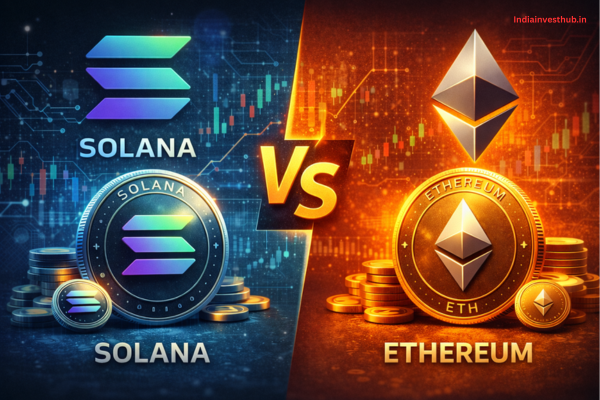
Solana is often compared to Ethereum, the dominant smart-contract platform.
Key differences:
- Speed: Solana is significantly faster
- Fees: Solana is cheaper
- Decentralization: Ethereum currently has more validators
- Ecosystem maturity: Ethereum remains larger overall
Ethereum dominates in total value and institutional adoption, but Solana competes aggressively on performance and user experience.
Many investors choose to hold both, viewing Solana as a high-growth complement rather than a replacement.
Risks and Challenges Facing Solana:
Solana is not without challenges:
- Past network outages and reliability concerns
- Validator centralization debates
- Competition from Ethereum Layer-2 solutions
- Regulatory uncertainty affecting all crypto assets
Network stability has improved significantly since earlier outages, but reliability remains a key metric investors monitor closely.
Future Outlook for Solana (SOL): Growth Potential and Adoption Trends
Solana’s future depends on:
- Continued technical improvements
- Growth in DeFi, NFTs, and Web3 adoption
- Expansion into payments and consumer applications
- Institutional and enterprise interest
Analysts increasingly classify Solana as a blue-chip Layer-1 blockchain, especially as usage metrics rebound strongly after market downturns (Source: Messari, CoinDesk Research).
If Solana continues to balance performance with stability, its long-term outlook remains compelling.
FAQs — Solana (SOL)
Q1: What is Solana used for?
👉Solana is used to run decentralized apps, process transactions, support NFTs, DeFi, gaming, and Web3 services.
Q2: Is SOL only for trading?
👉No. SOL is used for fees, staking, governance, and ecosystem participation.
Q3: Can SOL generate passive income?
👉Yes. SOL can be staked to earn network rewards.
Q4: Is Solana faster than Ethereum?
👉Yes, Solana processes transactions much faster, though Ethereum has a larger ecosystem.
Q5: Does Solana have long-term potential?
👉Many investors believe Solana’s speed, low fees, and growing ecosystem support long-term growth.
Conclusion:
Solana has positioned itself as one of the most technically ambitious and widely used blockchains in the crypto ecosystem. Its speed, low fees, staking rewards, and expanding developer base make SOL an attractive option for investors seeking exposure to scalable Web3 infrastructure rather than purely speculative assets. At the same time, competition and network reliability remain factors to watch closely.
As blockchain adoption continues to evolve globally, the real question for investors isn’t whether Solana can compete — but how confidently will you integrate Solana into your long-term crypto investment strategy?