Internal Rate of Return (IRR) is one of the most important metrics investors use to evaluate whether an investment is worth their money. If you’ve ever compared two projects, mutual funds, startups, or business opportunities and wondered which one truly offers better returns over time, IRR gives you that answer in percentage form.
According to Investopedia, IRR is the discount rate that makes the Net Present Value (NPV) of all cash flows equal to zero. In capital budgeting, IRR is widely used by companies to evaluate long-term projects, and financial analysts consider it a standard method for comparing profitability across investments. If you are serious about understanding returns beyond simple profit percentages, learning IRR is essential.
What is Internal Rate of Return (IRR)?
Internal Rate of Return (IRR) is the annualized rate of return at which the present value of future cash inflows equals the initial investment. In simple terms, IRR tells you the expected yearly growth rate of an investment based on projected cash flows.
Here’s what makes IRR powerful:
- It considers the time value of money.
- It accounts for multiple future cash inflows.
- It expresses profitability as a percentage.
For investors evaluating business projects, startups, real estate, or long-term investment opportunities, IRR helps answer one simple question:
Is this investment generating enough return to justify the risk?
IRR Meaning in Finance and Capital Budgeting:
In finance and capital budgeting, IRR plays a major role. Companies use IRR to evaluate projects like building a factory, launching a product, or acquiring another business.
If a project’s IRR is higher than the company’s required rate of return (also called the hurdle rate), the project is considered financially viable.
For example:
- Company’s required return = 12%
- Project IRR = 15%
- Result: Project is acceptable
Financial textbooks and sources such as Corporate Finance Institute explain that IRR is widely used because it simplifies complex financial projections into a single, easy-to-compare percentage.
Internal Rate of Return Formula Explained:
The IRR formula is based on the Net Present Value equation.
The core idea:
NPV = 0 = Σ [ Cash Flowₜ ÷ (1 + IRR)ᵗ ]
Where:
- Cash Flow = Future income from investment
- IRR = Rate of return
- t = Time period
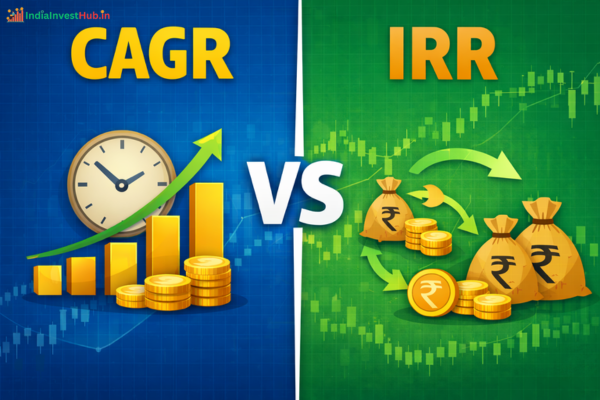
Unlike CAGR, IRR involves solving for the rate that makes NPV equal to zero. Because this requires trial-and-error or iterative calculation, most investors use financial calculators or Excel.
How to Calculate IRR:
Let’s walk through a simple example.
Example:
Initial Investment = ₹1,00,000
Year 1 Return = ₹30,000
Year 2 Return = ₹40,000
Year 3 Return = ₹50,000
Step 1: List Cash Flows
| Year | Cash Flow |
|---|---|
| 0 | -100,000 |
| 1 | 30,000 |
| 2 | 40,000 |
| 3 | 50,000 |
Step 2: Use Excel Formula
Type:
=IRR(values)
Example:
=IRR(A1:A4)
Excel will calculate the IRR automatically.
If Excel shows 18%, that means your investment generates an annual return of 18%.
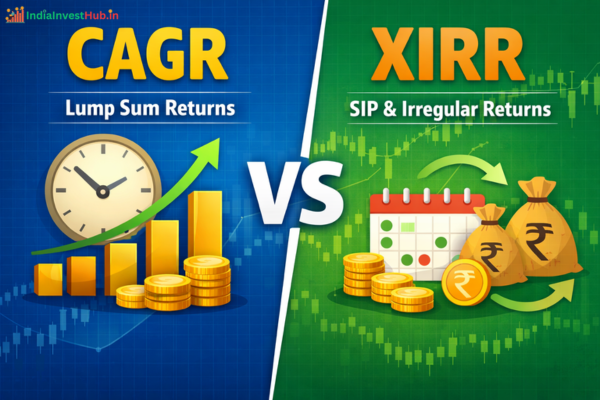
IRR vs XIRR vs CAGR – What’s the Difference?
| Feature | IRR | XIRR | CAGR |
|---|---|---|---|
| Cash Flow Frequency | Regular | Irregular | Single Investment |
| Best Used For | Projects & Business | SIP & Multiple Dates | Lump Sum |
| Complexity | Moderate | High | Simple |
| Time Value of Money | Yes | Yes | Yes |
Key Takeaways:
- Use IRR for structured cash flows.
- Use XIRR for irregular investments like SIPs.
- Use CAGR for simple lump sum growth.
Advantages of Internal Rate of Return:
1. Considers Time Value of Money
IRR discounts future cash flows.
2. Easy Comparison
Projects can be compared using percentages.
3. Useful in Capital Budgeting
Helps businesses allocate capital effectively.
4. Focuses on Profitability
Shows expected annual growth.
5. Widely Accepted Metric
IRR is a standard in corporate finance globally.
Limitations of IRR:
1. Assumes Reinvestment at Same Rate
IRR assumes future cash flows are reinvested at the same rate.
2. Multiple IRRs Problem
Some complex cash flow patterns produce multiple IRRs.
3. Ignores Project Scale
A small project with high IRR may generate less total profit than a larger project with slightly lower IRR.
4. Not Ideal for Irregular Dates
XIRR works better when dates vary.
What is a Good IRR Percentage?

A “good” IRR depends on the investment type and risk level.
- Equity markets historically deliver around 10–15% annually over long periods (various financial research reports).
- Venture capital often targets 20%+ IRR due to higher risk.
- Real estate projects may aim for 12–18% IRR.
Generally:
- IRR above inflation + risk premium is considered acceptable.
- Higher IRR usually indicates better profitability, but risk must be evaluated.
Common Mistakes While Calculating IRR:
1. Ignoring Cash Flow Timing
All dates must be accurate.
2. Forgetting Negative Initial Investment
Initial cost must be entered as negative.
3. Comparing IRR Alone
Always compare with NPV.
4. Not Considering Risk
Higher IRR doesn’t always mean safer investment.
5. Using IRR for SIP Instead of XIRR
This can produce inaccurate results.
Why Investors Should Understand IRR:

Investors who want to grow wealth intelligently need more than just profit numbers. IRR provides clarity about real annualized growth while considering the time value of money.
For example:
Investment A generates ₹50,000 profit in 3 years.
Investment B generates ₹50,000 profit in 5 years.
Absolute profit is same, but IRR reveals which one is truly better.
Understanding IRR helps investors:
- Compare business projects
- Evaluate startup investments
- Analyze real estate returns
- Make data-driven decisions
Without IRR, investment comparisons can become misleading.
FAQs – Internal Rate of Return (IRR)
Q1: What is IRR in simple words?
👉IRR is the annual percentage return that makes total investment value equal to total discounted cash flows.
Q2: Is higher IRR always better?
👉Generally yes, but risk and scale matter.
Q3: Can IRR be negative?
👉Yes, if project loses money.
Q4: Why does Excel show error in IRR?
👉You must include at least one negative and one positive cash flow.
Q5: Is IRR used in mutual funds?
👉For SIPs, XIRR is more accurate.
Conclusion:
IRR is a powerful financial metric that helps investors evaluate the profitability of projects and investments by considering the time value of money. It converts complex cash flow projections into a simple annual percentage, making comparison easier and decision-making smarter.
While IRR has limitations and should not be used alone without NPV and risk analysis, it remains one of the most widely used tools in finance and capital budgeting. Investors who understand IRR can evaluate opportunities more confidently, compare returns effectively, and allocate capital wisely. Now that you understand what IRR means, how it works, and how to calculate it.
So, are you ready to start analyzing your next investment using IRR?