Ethereum has become one of the most talked-about names in the investing world, not just because it’s a cryptocurrency, but because it powers an entire ecosystem of apps, finance tools, and digital assets. What Is Ethereum? A Beginner’s Guide to the World’s Leading Smart Contract Platform is really about understanding how this technology lets people build programs on a blockchain — from lending platforms to NFT marketplaces — all without banks or middlemen. Launched in 2015, Ethereum now processes millions of transactions every day and is second only to Bitcoin by market value.
For investors, that means Ethereum isn’t just a token called ETH; it’s the fuel for a massive decentralized network that developers, startups, and institutions are actively using. If you want to understand where digital finance and Web3 are heading, learning how Ethereum works — and why it matters — is one of the smartest first steps you can take.
Table of Contents
What Is Ethereum?
Ethereum is an open-source, decentralized blockchain platform that enables developers to build and run smart contracts and decentralized applications (dApps) without central intermediaries. While Bitcoin introduced the concept of digital money, Ethereum expanded that idea into a full-fledged computing platform on the blockchain. The native cryptocurrency that fuels the network is called Ether (ETH) — used to pay for transaction fees, computational services, and participation in decentralized networks.
This structure has attracted a wide range of projects, from financial tools to supply-chain tracking and digital collectibles. As of late 2025, Ethereum continues to host one of the most vibrant ecosystems in the cryptocurrency world.
How Ethereum Works: Blockchain, Nodes, and Smart Contracts Explained
At its core, Ethereum operates on a blockchain — a distributed digital ledger that records every transaction in a secure and transparent way. Unlike traditional financial systems that rely on centralized institutions, Ethereum’s blockchain is maintained by a network of nodes — individual computers running the Ethereum software and validating transactions.
Smart contracts are self-executing code stored on the blockchain that automatically enforce terms when certain conditions are met. For example, a smart contract can automatically transfer ownership of an asset once payment is confirmed. These programmable contracts remove the need for middlemen and unlock new possibilities for automation and trust.
Each time a transaction or smart contract executes, participants pay a small fee in Ether — often called “gas” — to compensate network validators for their computing resources and to prevent spam on the network.
What Makes Ethereum Different from Bitcoin? Key Comparisons

While both Bitcoin and Ethereum operate on blockchain technology, they serve distinct purposes:
- Purpose: Bitcoin is primarily a store of value and peer-to-peer currency. Ethereum is a global, programmable platform for building decentralized applications.
- Functionality: Ethereum supports smart contracts, whereas Bitcoin is more limited in scripting functionality.
- Flexibility: Developers use Ethereum to build finance, gaming, identity, and supply chain solutions.
These differences explain why many investors view Bitcoin as “digital gold” and Ethereum as the “world computer” — reflecting their respective roles in the digital economy.
What Are Smart Contracts and Why Are They So Powerful?
Smart contracts are one of Ethereum’s most transformative features. They are essentially computer programs that automatically enforce agreements between parties, removing the need for trusted intermediaries. Because they run on the blockchain, smart contracts are transparent, immutable, and tamper-proof once deployed.
This has massive implications for industries that rely on trust, verification, and contractual execution — including finance, insurance, real estate, and supply-chain management. Ethereum’s smart contracts power decentralized exchanges (DEXs), lending platforms, and automated marketplaces.
Understanding Ether (ETH): Ethereum’s Native Cryptocurrency
Ether (ETH) is the native cryptocurrency of the Ethereum network, and it plays multiple roles:
- Gas fees: Users pay in ETH to execute transactions and smart contracts on the network.
- Staking: After the transition to Ethereum’s upgraded consensus model, ETH can be staked to secure the network and earn rewards.
- Store of value and investment: Many investors hold ETH as a speculative asset or portfolio diversifier.
Ethereum’s economic design, including its fee market and post-upgrade supply dynamics, influences both utility and investor sentiment.
Popular Uses of Ethereum: DeFi, NFTs, dApps, and Web3
Ethereum’s flexibility has spurred a variety of innovative use cases:
- Decentralized Finance (DeFi): Financial tools like lending, borrowing, and decentralized exchanges operate without centralized banks.
- Non-Fungible Tokens (NFTs): Unique digital assets representing art, collectibles, and virtual real estate.
- dApps and Web3: Applications that run on decentralized infrastructure instead of centralized servers.
These applications have drawn billions in capital and millions of users, fueling Ethereum’s growth and broadening its appeal well beyond early cryptocurrency adopters.
How to Buy, Store, and Use Ethereum Safely as a Beginner:
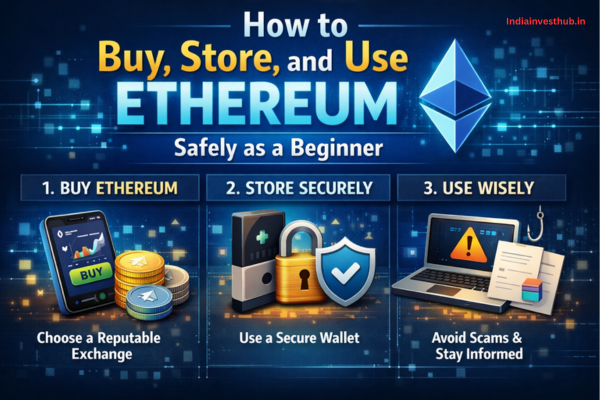
For investors ready to dive in, the basics of buying and securing Ethereum include:
Buying:
- Use reputable crypto exchanges with strong security practices and clear fee structures.
- Verify identity and payment methods according to local regulations.
Storing:
- Hot wallets: Online wallets accessible via apps or browsers — convenient but potentially more vulnerable.
- Cold wallets: Offline devices that store private keys securely — recommended for long-term holdings.
Using:
- Stay cautious with decentralized applications, especially those without established reputations.
- Avoid sharing private keys and enable two-factor authentication where possible.
Security and personal responsibility are paramount — once funds are transferred out of an exchange, the investor controls the keys and, therefore, the assets.
Ethereum 2.0 & Proof-of-Stake: What Changed and Why It Matters
The Ethereum network underwent a major upgrade known as Ethereum 2.0 (or the merge), transitioning from Proof-of-Work (PoW) to Proof-of-Stake (PoS) as its consensus mechanism. Instead of energy-intensive mining, PoS allows validators to stake ETH to participate in securing the network, which reduces energy consumption and aims to improve scalability.
This shift has significant implications:
- Lower energy use — making Ethereum more sustainable.
- Staking rewards — allowing ETH holders to earn yield.
- Scalability groundwork — laying the foundation for future layer-2 solutions.
Staking has become a popular way for investors to earn passive returns while supporting network security.
Risks of Investing in Ethereum: Volatility, Fees, and Security Concerns
As with all investments, Ethereum carries risks investors should consider:
- Price volatility: Crypto markets can swing dramatically based on sentiment, macro dynamics, and network developments.
- Transaction fees: Congestion on the Ethereum network can lead to high gas fees, especially during peak demand.
- Smart contract vulnerabilities: Bugs or exploits in decentralized protocols can lead to losses.
- Regulatory uncertainty: Jurisdictions around the world are still defining rules for digital assets.
Investors should be prepared for market ups and downs, use sound risk-management strategies, and gradually build exposure rather than committing large amounts at once.
Does Ethereum Have a Future? Adoption, Scaling, and Long-Term Potential
Many industry observers believe Ethereum’s future remains bright due to its foundational role in decentralized finance, digital ownership, and Web3 innovation. Scalability solutions — including layer-2 networks — continue to expand Ethereum’s capacity to handle more transactions at lower fees.
Institutional interest, ecosystem growth, and technological upgrades contribute to long-term optimism. However, competition from other smart-contract platforms and evolving regulations may influence outcomes.
FAQs – Ethereum
Q1: Is Ethereum better than Bitcoin?
👉They serve different purposes — Bitcoin as digital gold and Ethereum as a programmable platform.
Q2: Can Ethereum be hacked?
👉The core protocol is secure, but individual smart contracts or exchanges may be vulnerable.
Q3: Should beginners stake ETH now?
👉Staking can earn rewards, but it requires careful consideration of lock-up periods and market conditions.
Conclusion:
Ethereum has grown far beyond a simple digital currency. It is now the backbone of smart contracts, decentralized finance, NFTs, and the broader Web3 movement — a programmable blockchain that continues to shape how value and applications move across the internet. For investors, understanding Ethereum means recognizing both its innovation and its risks: price volatility, security concerns in poorly written smart contracts, and ongoing competition from other blockchains.
At the same time, upgrades like the shift to Proof-of-Stake, expanding developer activity, and rising institutional interest suggest that Ethereum will likely remain a dominant force in decentralized technology for years to come. Whether you’re exploring ETH as an asset or the wider ecosystem it powers, the key is education, risk awareness, and a long-term perspective.
Are you ready to decide what role Ethereum might play in your investment journey?