
Rohan once owned a small manufacturing venture in Chennai. One morning, his supplier called demanding immediate payment — a demand that left him scrambling. He realized that although his books showed “good profits,” he lacked enough liquid assets to settle short-term obligations. That vulnerable morning taught him a powerful lesson: profit does not always mean solvency.
It was this gap that drove Rohan to learn about Current Ratio, a tool that could have flagged his liquidity risk much earlier. At Indiainvesthub, we help curious readers and business owners like Rohan understand Current Ratio clearly — from its definition to how to improve it — so you never face a surprise liquidity crunch.
What Is Current Ratio?
Current Ratio is a key liquidity or working capital ratio that measures a company’s ability to pay its short-term obligations using its short-term assets. Formally:
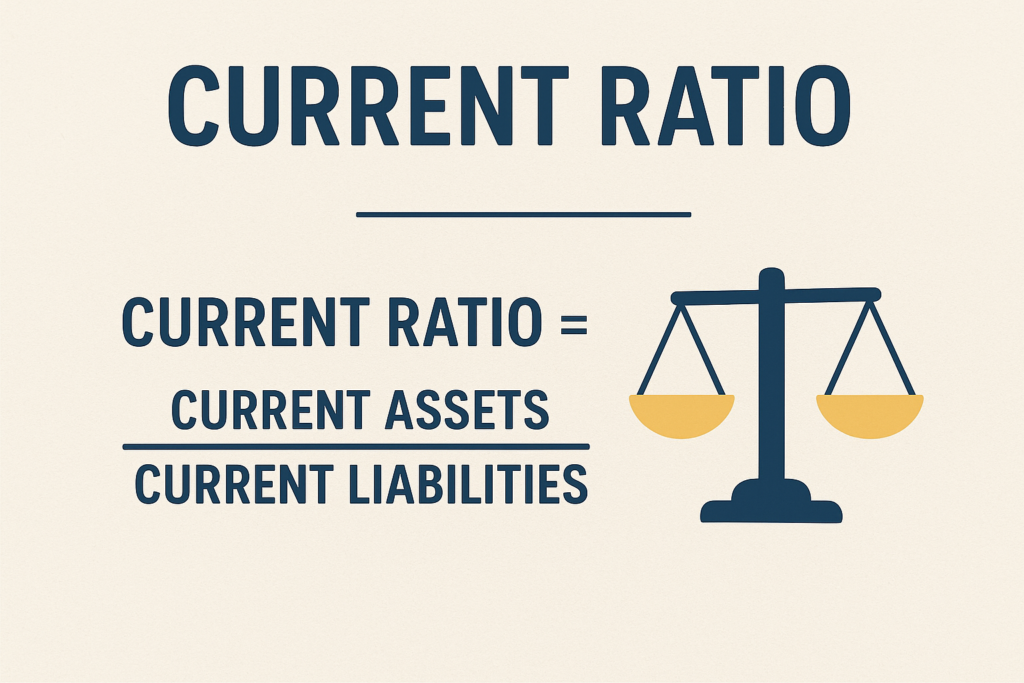
Current Ratio = Current Assets / Current Liabilities
“Current assets” include cash, accounts receivable, inventory, and other assets convertible to cash within one year. “Current liabilities” are debts or obligations due within one year (accounts payable, short-term loans, accrued expenses).
If the ratio is above 1, the company has more current assets than liabilities; below 1 suggests trouble meeting short-term demands.
Formula and Calculation:
Let’s walk through the Formula and Calculation:
- Formula:
Current Ratio = Current Assets / Current Liabilities
- Components:
- Current Assets = Cash + Marketable Securities + Accounts Receivable + Inventory + Other current assets
- Current Liabilities = Accounts Payable + Short-term Debt + Accrued Expenses + Other current liabilities
- Example (India context):
Suppose Ambuja Cements has:- Current Assets = ₹14,31,90,100
- Current Liabilities = ₹9,07,03,100
Then the current ratio = 14,31,90,100 ÷ 9,07,03,100 ≈ 1.57
That means Ambuja has ₹1.57 in current assets for every ₹1 of short-term debt — a comfortable position, though not without caution.
Interpretation of the Current Ratio:
Once you calculate the ratio, here’s how to interpret it:
- Ratio > 1: The firm can cover short-term liabilities with current assets.
- Ratio = 1: Exactly balanced — not much cushion.
- Ratio < 1: Potential liquidity risk; may struggle to meet obligations.
- Very high ratio (e.g., > 3): Could suggest inefficiency — excess idle assets or too much cash sitting unused.
A ratio at a point in time is just a snapshot. It may hide issues like slow receivables or obsolete inventory. That’s why analysts often look at trends over multiple periods and compare with industry peers.
Components:
Understanding the ingredients is vital:
- Current Assets
- Cash & cash equivalents – the most liquid
- Accounts Receivable – amounts owed by customers
- Inventory – raw materials, work-in-progress, finished goods
- Other current assets – prepaid expenses, short-term investments
- Current Liabilities
- Accounts Payable – amounts owed to suppliers
- Short-term debt / notes payable
- Accrued expenses – wages, taxes, utilities
- Current portion of long-term debt
Because inventory is not always instantly liquid, reliance on it in the numerator can overstate liquidity. That’s why the Quick Ratio (excluding inventory) is sometimes favored.
Advantages:
Why do analysts and investors care about it?
- Simplicity – easy to compute from balance sheet figures.
- Snapshot of liquidity – indicates short-term financial health.
- Comparative insight – useful when comparing companies in same industry.
- Trend analysis – over time, shifts can signal improving or deteriorating liquidity.
- Red flag detection – identifying potential liquidity stress early.
Limitations:
But it’s not perfect — here are caveats:
- Ignores quality of assets – slow receivables or unsellable inventory weaken actual liquidity.
- Timing matters – cash inflows and outflows may not align with balance sheet date.
- Industry differences – benchmarks vary; what’s good in retail may be weak in heavy industry.
- Static measure – offers snapshot, not dynamic view of cash flows.
- Misleading if too high – may indicate underutilized assets or inefficient management.
Industry Benchmarks and Comparisons:
What constitutes a “good” current ratio depends heavily on industry norms and context:
- A typical ideal range often cited is 1.5 to 2.0
- Some sources say a broader acceptable band is 1.2 to 2.0, acknowledging variation across geographies and sectors.
- ReadyRatios tracks industry medians (U.S.) across thousands of firms to benchmark typical current ratios.
- Always compare within your industry (e.g., manufacturing, retail, services) and region. A high current ratio in capital-intensive industries can be different from that in service or tech firms.
Difference Between Current Ratio and Other Liquidity Ratios:
| Liquidity Ratio | Formula / Focus | Strengths | Drawbacks |
|---|---|---|---|
| Current Ratio | Current Assets ÷ Current Liabilities | Broadest measure of short-term liquidity | May overstate liquidity due to slow assets |
| Quick Ratio (Acid Test) | (Current Assets – Inventory) ÷ Current Liabilities | Excludes inventory — more stringent | Ignores some assets like prepaid expenses |
| Cash Ratio | (Cash + Cash equivalents) ÷ Current Liabilities | Ultra-conservative; focuses on cash | May understate liquidity by ignoring other liquid assets |
| Operating Cash Flow Ratio | Operating Cash Flow ÷ Current Liabilities | Shows ability to generate cash flow | Depends heavily on cash flow timing |
For example, if a firm has a current ratio of 2.0 but much of that is tied up in inventory, its quick ratio may drop to 1.2, revealing less flexibility in covering liabilities.
Improving the Current Ratio:
If your current ratio is weak, here are strategies to strengthen it:
- Speed up receivables: tighten credit terms or incentives for early payments
- Reduce inventories: lean inventory management (e.g. JIT or better forecasting)
- Negotiate better payables terms: extend payables where possible without harming supplier relations
- Convert short-term debt to long-term: shift obligations beyond one year
- Build cash reserves: retain earnings or raise capital
- Dispose of non-core current assets: free unused asset capacity
FAQs – Current Ratio
Q1: What is a perfect current ratio?
👉There is no one perfect number — context matters. Many analysts treat 1.5 to 2.0 as a healthy zone, but acceptable standards vary by industry.
Q2: Can a ratio above 3 be bad?
👉Yes — it might signal that the company is hoarding cash or not deploying assets efficiently.
Q3: How often should you track current ratio?
👉Quarterly or annually is normal. But for fast-changing businesses, monthly monitoring may help.
Q4: Is current ratio enough to evaluate liquidity?
👉On its own, it’s limited. Use with quick ratio, cash flow ratios, and trend analysis.
Q5: Can a low current ratio always mean danger?
👉Not necessarily — some firms manage cash flows tightly and still pay obligations on time. Also, strong credit lines or committed working capital can offset a low ratio.
Conclusion:
Current Ratio offers a crisp, intuitive window into a company’s short-term liquidity — whether it can meet imminent obligations using its current assets. For business owners, investors, and financial analysts, it’s a first line of defense: a red flag if too low, a signal of complacency if too high. But it must be interpreted alongside other ratio metrics, industry norms, and qualitative factors like receivables aging and inventory turnover.
Would you like us to build a customizable current ratio calculator or a step-by-step auditing guide for your specific business sector?