
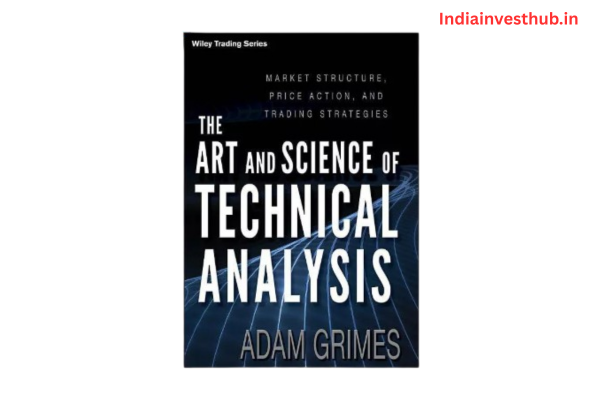
The Art and Science of Technical Analysis begins with the hum-of a trading floor just before dawn, when a lone chart flickers, and a trader thinks: “Why does this keep happening?” Michael—a young trader in Mumbai—watched the Nifty futures bounce, stall, and reverse. He knew how to draw trendlines, but he didn’t know why the bounce failed. He picked up The Art and Science of Technical Analysis by Adam Grimes and found answers: not just “here’s how” but “here’s why”.
At 480 pages, this book dives deep into market structure, price action, statistics, psychology, and strategy. For readers who want the secret behind The Art and Science of Technical Analysis, here’s how we at Indiainvesthub unpack its core lessons and help you translate them into actionable insight for Indian markets.
The Art and Science of Technical Analysis: An Overview
At its heart, The Art and Science of Technical Analysis is a book that seeks to bridge two seeming opposites: the measurable, quantitative “science” of markets, and the intuitive, discretionary “art” of trading. Grimes writes that while markets may often appear chaotic, the existence of a verifiable edge is non-negotiable.
In the overview, the book is split into four major parts: the foundation of technical analysis; market structure; trading strategies; and the individual trader (including psychology).
🔗 Check Price on Amazon
Price Range in India: ₹5,081 – ₹5,981
The Core Philosophy of the Book
The secret begins with two core premises: first, markets are largely random and efficient — but not always. Grimes emphasises this upfront. Second, the only way to profit is by identifying imbalances in buying vs selling pressure, which create exploitable edges. He states: “Every edge we have, as technical traders, comes from an imbalance of buying and selling pressure.”
For the reader: you can’t simply learn a generic chart pattern and hope it works across all markets. You must learn to assess context, structure, behaviour, and probability. The “secret” is not a shortcut — it’s a systematic mindset.
The Foundation: Market Structure
Grimes devotes significant content to the concept of market structure — the environment in which price moves: trends, ranges, and the interfaces between them.
He explains that in a trend, imbalances are easier to identify (strong buying or selling). In ranges, price action becomes more random and patterns more deceptive.
For the reader: knowing whether a market is trending, ranging or at a transition gives you the secret ability to choose the right patterns or decide to avoid false ones.
The Role of Price Action
Price action — reading how price moves, not just static indicators — is central in Grimes’ work. He argues that indicators are derivatives of price, and that understanding the game starts with supply/demand, not with moving averages per se.
He writes that in his opinion: “we do not trade patterns in the market–we trade the underlying imbalances that create those patterns.”
For readers: the secret is shifting focus from what pattern is visible to why it formed.
Top 10 Technical Analysis Books
The Science of Probability and Statistics
Here is where the “science” part kicks in. Grimes emphasises statistical validation — that patterns only matter when they show up in robust data sets, and only when they reflect real supply/demand imbalance.
He also warns about data-mining bias — selecting only good results and ignoring the noise. This guards against self-delusion.
For the reader: adopt a quantitative mindset. Don’t rely on “this worked once” — test across time, across markets.
The Psychology of Trading
Trading is not just numbers and charts — it’s also mindset. Grimes dedicates a full section to the trader’s mind: the biases, the emotional hooks, the illusions.
He outlines phases in a trader’s development and notes how many fail because they don’t recognise that even the best strategy fails sometimes — consistency, discipline, review matter.
For the reader: your own psychology is part of the trading edge.
Developing a Trading Edge
In Grimes’ view, your trading edge is the combination of three core parts: market structure understanding, validated pattern/strategy, and your own execution discipline.
He emphasises you must define your edge, test it, execute it consistently. Without that, patterns are meaningless.
For readers: the secret behind the book is not memorising a list of patterns, but designing your unique edge based on your style, timeframe, and market.
5 Best Books to Learn Fundamental Analysis
The Art: Pattern Recognition and Context
Grimes labels the “art” side of the trading equation as recognising patterns in context. It’s not enough to say “this is a head-and-shoulders” — the question is: what environment, what volume, what participation created it? He emphasises that patterns are helpful only when backed by underlying imbalance.
He also warns that in many cases patterns fail because traders ignore context (trend vs range, market exposure, structural shifts).
For readers: the secret is developing pattern recognition plus contextual filters then practice.
Risk Management Principles
No matter how good your analysis, if you cannot manage risk you will lose. Grimes dedicates significant chapter space to risk and trade management: position sizing, stop placement, managing losing trades, etc.
He writes that many traders focus on entry but ignore management – that is a key source of failure.
For the reader: your edge is only as good as your smallest acceptable loss.
Strategy Development and Backtesting
Putting together your edge means creating a strategy and backtesting it. Grimes emphasises you must apply your historically tested setup across different timeframes and market regimes.
He also warns that a strategy that works in one regime may fail when conditions shift — so you must understand the structure and reason behind it.
For readers: build your strategy logic, back-test it, understand its failure modes.
The Role of Intuition in Trading

Finally, on the “art” end of the spectrum, Grimes acknowledges that intuition plays a valid role – but only when it’s trained, tempered by objective criteria and tested through experience. He warns that untrained intuition is just gut feelings and dangerous.
For readers: the secret is that intuition is earned, not given. It comes through screen-time, sense-making, feedback loops.
FAQs – The Art and Science of Technical Analysis by Adam Grimes
Q1: Is this book for beginners?
👉While the Art and Science of Technical Analysis book covers foundational topics, the depth of study is rich and requires disciplined reading. One reviewer notes: “This book is not for the casual reader… it’s for those who want to become a trader or become a better trader.”
Q2: Does this book provide a ‘done-for-you’ system?
👉No. Grimes emphasises that he doesn’t present a rigid system that guarantees success. Instead he provides the frameworks and tools to develop your own edge.
Q3: How relevant is it for Indian markets (NSE/BSE/India)?
👉Though the Art and Science of Technical Analysis book uses global markets and examples, the underlying principles – imbalance, structure, price action – are universal.
Q4: How long will it take to digest the concepts?
👉Given the book is around 480 pages and dense in content. Many traders report requiring multiple reads and active chart work to internalise the concepts.
Q5: Does statistical validation really matter?
👉Yes – according to Grimes many traders fail because they chase visual patterns without verifying their performance across data. The book emphasises the science of probability.
Conclusion:
The Art and Science of Technical Analysis by Adam Grimes is more than just another technical-analysis book—it is a comprehensive roadmap for traders who want to understand markets, not merely apply patterns blindly. For those readers who want the secret behind The Art and Science of Technical Analysis, remember: it lies in the intersection of structure + action + statistics + psychology + risk + pattern + intuition.
Are you ready to uncover that secret for yourself?


