
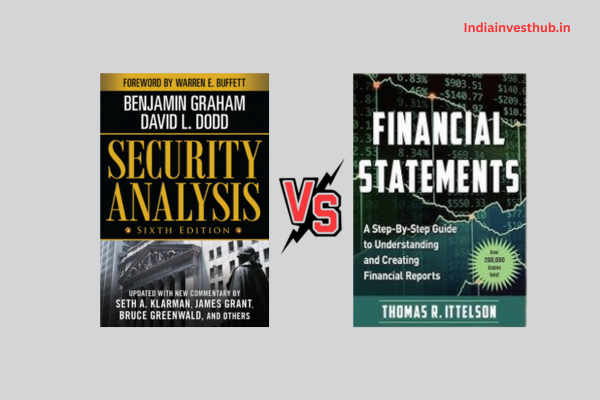
When Ramesh, a young professional in Mumbai, received his first promotion, he decided it was finally time to invest his savings wisely. He bought a few stocks based on tips from colleagues, but within months, his portfolio value dropped by 20%. Frustrated, he realized investing wasn’t about luck or hearsay—it was about knowledge. That’s when he stumbled upon two highly recommended books: Security Analysis by Benjamin Graham and David Dodd, and Financial Statements: A Step-by-Step Guide to Understanding and Creating Financial Reports by Thomas Ittelson. But like many readers today, he asked himself—which book is best for me?
This is exactly where the discussion of Security Analysis vs Financial Statements becomes vital for anyone serious about learning investing. According to Statista, over 130 million retail investors were actively participating in stock markets worldwide in 2024, and the number is growing rapidly (Statista, 2024). With so many new investors, choosing the right foundational book can make or break your financial journey. At Indiainvesthub, we help readers cut through the noise and decide which resource fits their unique learning style and goals.
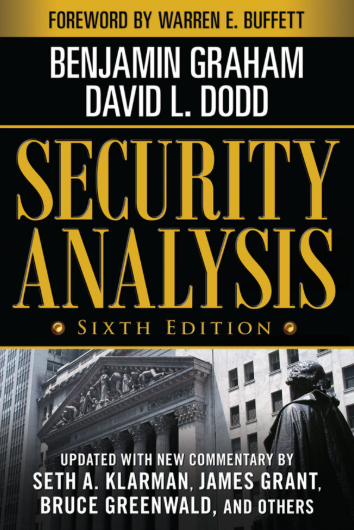
1) Security Analysis by Benjamin Graham and David Dodd: An Overview
Originally published in 1934 during the Great Depression, Security Analysis is considered the “Bible of Value Investing.” It has stood the test of time by shaping the minds of legendary investors, including Warren Buffett.
🔗Buy on Amazon
Price Range in India: ₹4,596 – ₹4,796
Key Features:
- Deep Value Investing Principles – Focuses on identifying undervalued securities through intrinsic value analysis.
- Rigorous Analytical Framework – Emphasizes margin of safety, bond analysis, and stock valuation.
- Comprehensive Case Studies – Includes real-world corporate data and examples.
- Historical Legacy – Six editions spanning almost 90 years, each updated to reflect financial market changes.
Pros:
- Classic framework still relevant in modern investing.
- Provides a structured methodology for evaluating stocks and bonds.
- Endorsed by leading investors worldwide.
Cons:
- Very dense and academic; not beginner-friendly.
- Heavy focus on valuation, limited coverage on behavioral finance or modern market dynamics.
Real Customer Experiences:
👉“It is impossible not to give this book five stars. It is the reference upon which all serious value investors base their analyses. It goes much deeper than The Intelligent Investor by the same author, which is more easily digestible. Security Analysis requires more involvement and multiple readings to be fully assimilated, but it is worth the effort.”
👉“I’ve read many suggestions on which edition to purchase, and the sixth edition stands out as fantastic. Successful investors have shared their views on specific chapters, which are a good read considering their background and perspectives on the texts that follow. The edition is well-printed and easy to read. I would definitely recommend this edition for purchase.”
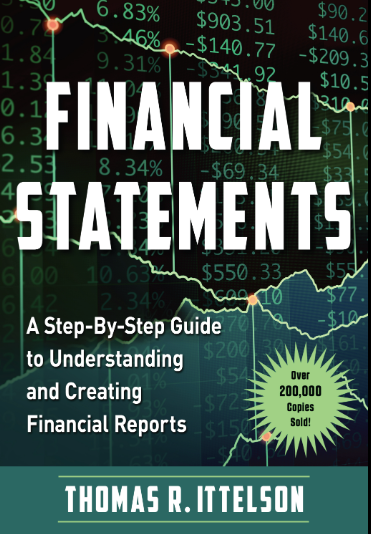
2) Financial Statements: A Step-by-Step Guide to Understanding and Creating Financial Reports by Thomas Ittelson – An Overview
First published in 1998, this book is widely recognized as one of the best introductions to financial statements for non-accountants. It simplifies balance sheets, income statements, and cash flow statements in a way that anyone—even those without a finance background—can understand.
🔗Buy on Amazon
Price Range in India: ₹1,696 – ₹1,896
Key Features:
- Plain Language Explanations – Focuses on clarity rather than jargon.
- Step-by-Step Breakdown – Guides readers through the process of reading and creating financial reports.
- Practical Focus – Useful for small business owners, entrepreneurs, and new investors.
- Visual Aids – Charts and examples make concepts more digestible.
Pros:
- Extremely beginner-friendly.
- Helps readers build confidence in reading company reports.
- Applies to both personal investing and business decision-making.
Cons:
- Lacks advanced investing strategies compared to Graham’s work.
- More accounting-focused than investment-focused.
Real Customer Experiences:
👉“I have read many books on financial statements and analysis, but this is the easiest and most accessible. It is also very comprehensive, covering all the essential points. This is the best book to learn about financial statements. It will behoove every fundamental stock investor to buy and read it. I wholeheartedly recommend this book.”
👉“I used this book for a business course in college, and it was extremely helpful. It breaks down financial concepts in a clear and straightforward way, making them easy to understand even for beginners. Whether you’re a student or simply looking to improve your financial literacy, this is a solid choice. The book arrived in perfect condition with fast shipping. I’d recommend this textbook to anyone needing a strong foundation in financial statements.”
Top 5 Best Books to Learn Fundamental Analysis for Beginners and Investors
Security Analysis vs Financial Statements – Comparison Table
Feature | Security Analysis (Graham & Dodd) | Financial Statements (Thomas Ittelson) |
|---|---|---|
Image |  |  |
First Published | 1934 | 1998 |
Core Focus | Value investing & intrinsic valuation | Understanding financial reports |
Target Audience | Advanced investors, finance professionals | Beginners, entrepreneurs, new investors |
Complexity Level | High – academic and technical | Low – easy to understand |
Practical Application | Stock picking, bond analysis, margin of safety | Reading and preparing financial reports |
Reader Feedback | Deep but challenging | Simple and practical |
Ratings | 4.7 Out of 5 | 4.6 Out of 5 |
Buy |
Top 10 Technical Analysis Books Every Trader and Investor Should Read
FAQs – Security Analysis vs Financial Statements
Q1: Which book should a beginner start with?
👉Beginners will benefit more from Financial Statements as it introduces financial reports in plain language.
Q2: Is Security Analysis still relevant in 2025?
👉Yes. Despite being written decades ago, its principles of intrinsic value and margin of safety remain timeless.
Q3: Do I need both books?
👉Ideally, yes. Financial Statements builds your foundation in accounting basics, while Security Analysis teaches you how to apply those fundamentals to investing.
Q4: Which book is shorter and easier to finish?
👉Financial Statements is far shorter and easier. Security Analysis is long and detailed.
Q5: Are these books useful for business owners as well as investors?
👉Absolutely. Financial Statements is especially relevant for business owners, while Security Analysis is geared more toward professional investing.
Conclusion:
So, Which One Should You Choose?
- If you are a beginner with no background in accounting or investing → Start with Financial Statements.
- If you are an experienced investor or want to dive into professional-level investing → Choose Security Analysis.
- If you want a complete journey from basics to mastery → Read both in sequence.
Both books are highly valuable, but the right choice depends on your current knowledge and future investing goals. So, which one should you choose?


