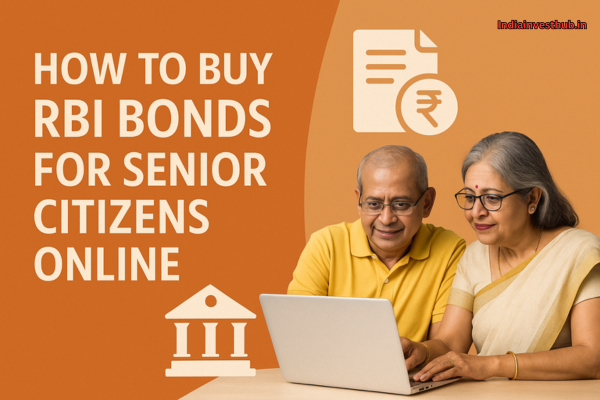
RBI Bonds for senior citizens online is something every investor looking for safe, steady returns should understand right now. As you evaluate options to secure your retirement or build a conservative income stream, learning how to buy RBI Bonds for senior citizens online becomes a key piece of your strategy. In this piece we’ll walk you through the full process — what these bonds are and why they’re attractive for senior citizens, who’s eligible, how you buy them online, what the terms and tax implications are, how they compare with alternatives, and finally answer the common questions investors have.
What Are RBI Bonds and Why They’re Ideal for Senior Citizens?
When the Reserve Bank of India issues bonds (specifically the “Floating Rate Savings Bonds” or similar savings-bonds) they’re essentially offering the Government of India’s backing. That means credit-risk is extremely low. Many senior citizens prefer safety over high risk, so these bonds appeal. For example, the current interest rate on the floating-rate bonds is 8.05 % per annum (for Jan–Jun 2024) and gets reset every six months.
Why are they particularly appropriate for senior citizens?
- Semi-annual interest payout: You get interest twice a year (on 1 Jan and 1 July) in most cases.
- Early or premature redemption options for senior age groups: For example, if you’re aged 60-70 you can exit after 6 years instead of full 7-year term.
- No maximum investment limit: You can invest as much as you like (in ₹1,000 multiples) to build a larger income stream.
In short: For an investor – particularly a senior citizen – who wants a safe, government-backed instrument that delivers predictable periodic income and is relatively straightforward, these bonds are very relevant.
Bonds Explained: A Complete Beginner’s Guide to Fixed Income Investments
Eligibility Criteria: Who Can Buy RBI Bonds Online in India?
Here’s what you need to know about eligibility:
- The investor must be a resident Indian (i.e., Non-Residents/NRIs are not permitted for these bonds) in most cases.
- It can be held by an individual, jointly (on ‘any-one or survivor’ basis), or even a Hindu Undivided Family (HUF).
- For the senior-citizen benefits (like early exit), your age matters: 60 yrs+, 70 yrs+, 80 yrs+ have specified earlier withdrawal rules.
- Minimum investment starts at ₹1,000 (or multiples thereof) and there is no upper limit for most investors.
So if you’re an Indian resident above age 60, you tick both the general eligibility and the senior-citizen special category for easier exit. For investors wanting to know how to buy RBI Bonds for senior citizens online, confirming your eligibility first is the logical first step.
Step-by-Step Guide: How to Buy RBI Bonds for Senior Citizens Online
Here’s a smooth sequence for investors looking to buy online:
- Choose an authorised bank or platform (see next section) and ensure you have internet banking or digital access set up.
- Log in to the bank’s portal or the specified bond purchase portal (for example via the RBI Retail Direct platform or bank’s “Invest in Government Securities” section).
- Select the bond issue (e.g., FRSB – Floating Rate Savings Bonds) and indicate you are a senior citizen (if applicable) to avail early exit features.
- Fill in the application details: name, age, date of birth, PAN, bank account, investment amount (₹1,000 multiples) and interest payment preference (bank credit).
- Upload required documents (identity, address, age proof) and accept terms & conditions.
- Make payment via electronic mode (cheque/draft/cash within limits) and submit the form.
- Upon successful application, you’ll get a Bond Ledger Account (BLA) in your name and a certificate of holding. The interest payments will begin as per next cycle (for example 1 Jan or 1 July).
As an investor you want to know the process is as friction-free as possible—so have your documents ready, your bank account enabled, and ensure you indicate you’re a senior citizen to reap those extra perks.
Documents Required for Senior Citizens to Purchase RBI Bonds
To get the process done smoothly, these are the key documents you’ll need:
- PAN card (mandatory for all applicants).
- Proof of identity and address (Aadhaar, Passport, Voter ID, etc).
- Date of birth proof (especially important for senior-citizen benefits).
- Cancelled cheque or bank account details for interest credit.
- Completed application form of the bond issue (online upload or scanned copy).
Keep these ready ahead of time so when you decide to act you can complete the online transaction without delay.
Where to Buy RBI Bonds Online: Authorized Banks & Platforms
Investors looking to buy RBI Bonds for senior citizens online have multiple platforms:
- Many large banks act as designated receiving offices (branches) for the bond issues e.g., State Bank of India (SBI), nationalised banks, and major private banks.
- The “RBI Retail Direct Portal” (launched by RBI) is an increasingly used platform for retail investors to buy government securities.
- Via net-banking of your bank if that bank supports the bond subscription process; look for “Invest in Government Bonds / Savings Bonds” section.
For senior investors, online purchase means you avoid queueing at a branch and the documentation upload and bank account linkage make it convenient.
Interest Rate of RBI Bonds for Senior Citizens: Latest Updates
Here are the recent rate and related facts which matter for you as an investor:
- The current coupon rate on the floating rate savings bonds is 8.05% per annum for the period Jan-June 2024, payable semi-annually.
- The rate is reset every six months, and it’s benchmarked at NSC rate + 0.35%.
- Because the rate adjusts, there’s inflation protection built-in to a limited extent (unlike a fixed deposit which is locked).
As an investor, you’ll want to bookmark the next reset date (1 July or 1 January) and monitor the NSC rate changes accordingly.
Investment Limits, Lock-In Period & Premature Withdrawal Rules
These are the terms that senior-citizen investors must note:
- Minimum investment: ₹1,000 (and in multiples of ₹1,000).
- No upper limit on how much you can invest in most cases.
- Standard tenure: 7 years from date of issue for most investors.
- For senior citizens early withdrawal or encashment options:
- Age 60-70 yrs: exit after 6 years.
- Age 70-80 yrs: exit after 5 years.
- Age 80+ yrs: exit after 4 years.
- Penalty: Early exit carries a penalty of 50% of the last six-months interest paid (for senior citizen exit).
For an investor deciding how to buy RBI Bonds for senior citizens online, it’s critical to align your investment horizon with these exit rules and understand there is some illiquidity until the minimum lock-in lapses.
How Interest Payment Works in RBI Bonds for Senior Citizens
Interest payments matter for income-planning:
- Interest is paid semi-annually (for example on 1 Jan and 1 July) via bank credit into your registered account.
- Because the rate is floating, the amount you receive every six months may change if the benchmark moves.
- The interest is fully taxable as “Income from other sources” and there’s no tax-free component. TDS may apply if interest crosses a threshold.
So you, as an investor, will be able to count on periodic cash-flows (helpful for retirement income), but you must plan for tax on that interest.
Safety, Risks & Taxation of RBI Bonds for Senior Citizens
Safety:
Since the bonds are issued by the Government of India (via RBI) the credit risk is essentially nil. That makes them a safe sleeve in a conservative portfolio.
Risks:
- The interest rate is floating, which means if benchmark rates fall your yield could decline.
- Liquidity is poor: You cannot sell these bonds on the secondary market (they are non-transferable) and exit is constrained by lock-in periods.
- Tax on interest reduces net return: since interest is taxable, your post-tax yield depends on your tax slab.
- Inflation risk: Although the rate is floating, it may not fully compensate for inflation, so real returns could be modest.
Taxation:
- The interest earned is taxable under the Income-tax Act.
- Wealth-tax is exempt.
- TDS may be deducted if interest crosses certain thresholds.
From an investor’s standpoint, the suitability of these bonds depends on your tax rate, other income streams, and whether you need liquidity.
RBI Bonds vs Other Senior Citizen Investment Options: Which Is Better?
Let’s compare these bonds with alternatives often in the senior-citizen portfolio:
- Fixed Deposits (FDs): Many banks offer 8%-8.4% for senior citizens in five-year FDs. But there’s risk (bank credit risk), rate may be fixed and inflexible, and some are linked to small finance banks. The floating-rate RBI bond offers a higher rate than many standard bank FDs and gets government backing.
- Senior Citizen Savings Scheme (SCSS): Offers safe income but has shorter term (5 years) and lower flexibility perhaps.
- Government Securities (G-Sec): Extremely safe but may require larger sums and may not pay semi-annual interest as conveniently.
- Post Office Schemes: Safe, but may offer lower rates, and liquidity might be limited.
So for an investor wanting safe income and government backing, and who is willing to lock in for 5-7 years (with earlier exit option if 60+), the RBI bond comes out very favourably.
FAQs – Buy RBI Bonds for Senior Citizens Online
Q1: Can senior citizens buy these bonds entirely online without visiting a branch?
👉Yes — many banks and the Retail Direct portal enable online application, uploading documents and payment electronically. You may still require age proof, PAN and bank account linkage.
Q2: Is there a maximum investment limit for senior citizens?
👉No, there’s no specified upper limit; you can invest in multiples of ₹1,000 with minimum ₹1,000.
Q3: If I invest at age 65, when can I withdraw early?
👉If you are aged 60-70 at investment, early withdrawal is allowed after 6 years.
Q4: Is the interest rate guaranteed?
👉No — it’s a floating rate (reset every six months). While it has recently been 8.05% per annum, future resets could change.
Q5: How is the interest taxed?
👉Interest is taxable as “Income from other sources” and subject to TDS if applicable.
Conclusion:
RBI Bonds for senior citizens online are a compelling proposition for conservative investors seeking safe, government-backed income. If you’re an investor wanting to know exactly how to buy RBI Bonds for senior citizens online, and you have the documents, bank account and eligibility sorted, then the process is fairly streamlined. The semi-annual interest payments, the early exit option for those aged 60+ and the lack of a cap on investment make it particularly suitable as a core part of a retirement-income or conservative allocation. However, you’ll want to keep in mind the floating nature of the yield and your own tax status.
If you have questions about choosing the best bank platform, the exact timing of purchase, or combining RBI bonds with other options, would you like me to walk you through that next?