High-Yield Bonds often catch the eye of investors searching for higher returns, especially during times when traditional fixed-income products deliver modest yields. According to the Securities Industry and Financial Markets Association (SIFMA), the global high-yield bond market is valued at over $1.7 trillion, and its influence continues to grow as more companies use these instruments to raise capital. Many investors are drawn to the potential for double-digit yields, especially when compared to investment-grade bonds or government securities. But higher returns always come with trade-offs, making it essential for investors to understand what high-yield bonds truly offer, the risks involved, and whether they align with their risk tolerance and long-term financial goals.
This article breaks down everything investors need to know so they can evaluate high-yield bonds with confidence, clarity, and realistic expectations.
What Are High-Yield Bonds and Why Are They Called “Junk Bonds”?
High-yield bonds are corporate bonds issued by companies with credit ratings below investment grade—typically below BBB- (S&P and Fitch) or Baa3 (Moody’s). Ratings agencies classify them as higher-risk because the issuing company may have weaker financial stability, volatile earnings, or higher debt levels. For this reason, they are often called “junk bonds,” a term that reflects their elevated risk of default rather than the quality of the companies themselves.
However, “junk” doesn’t mean worthless. Many high-yield issuers are growing companies, undergoing restructuring, or operating in cyclical industries with potential for recovery. In fact, during some market cycles, high-yield bonds outperform investment-grade bonds. According to Morningstar, high-yield bond indices returned an average of 7.2% annually over the last two decades, outpacing many traditional fixed-income categories. Investors accept the additional risk in exchange for higher interest payments.
Bonds Explained: A Complete Beginner’s Guide to Fixed Income Investments
How High-Yield Bonds Work: Issuers, Ratings & Return Structure
High-yield bonds function similarly to regular corporate bonds. Investors lend money to the issuer in exchange for periodic coupon (interest) payments and the return of principal at maturity. What makes them different is the issuer’s risk profile. Companies issuing high-yield bonds often:
- Have lower credit ratings
- Operate in industries facing volatility
- Need capital for expansion, refinancing, or restructuring
- Have higher debt-to-income ratios
Because investors demand compensation for taking on greater risk, high-yield bonds offer higher coupon rates—sometimes 2 to 4 percentage points more than investment-grade bonds (Source: Moody’s Market Insights). Returns typically include:
- Coupon income (main source of return)
- Price appreciation when bond spreads tighten
- Potential capital gains when credit outlook improves
High-yield bonds are sensitive to both company performance and broader economic conditions, which means investors should understand the issuer’s fundamentals before buying.
Key Opportunities: Why Investors Seek High-Yield Bonds
High-yield bonds offer several benefits that appeal to income-focused and risk-tolerant investors:
1. Higher Income Potential
The biggest attraction is their high coupon rates. In strong economic periods, yields can exceed 8–10%, far surpassing investment-grade yields (typically 3–5%) (Source: ICE BofA High Yield Index).
2. Better Returns During Economic Growth Cycles
When markets are stable and companies perform well, high-yield bonds tend to outperform other bonds. A growing economy reduces default risk, improving investor confidence.
3. Lower Interest Rate Sensitivity
Compared to long-term government bonds, high-yield bonds are less sensitive to interest rate changes because their higher coupons offset some price fluctuations.
4. Potential for Capital Gains
If a company’s financial health improves, credit ratings can be upgraded, sharply increasing the bond’s value.
5. Portfolio Diversification
High-yield bonds behave differently from traditional bonds and sometimes move more like equities. This can provide diversification and reduce overall portfolio volatility when managed properly.
Major Risks: Default Risk, Liquidity Risk & Market Volatility
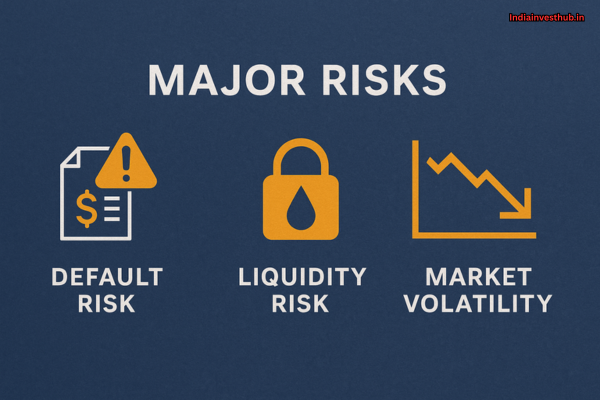
High-yield bonds come with real risks that investors must evaluate carefully.
1. Default Risk
Companies with low credit ratings have a higher chance of missing interest payments or failing to repay principal. According to Moody’s, the long-term average default rate for high-yield bonds is 4–5%, compared to 0.1% for investment-grade bonds.
Unlike government bonds, high-yield bonds can be harder to sell quickly without accepting a lower price. Liquidity tends to dry up during market stress.
3. Economic Sensitivity
During recessions, high-yield bonds face sharp declines. In 2008, the high-yield market fell 26%, and in early 2020 during the COVID-19 shock, it dropped nearly 20% in weeks (Source: Bloomberg High-Yield Index).
4. Credit Spread Risk
High-yield bonds depend heavily on credit spreads—the difference between yields on high-yield and government bonds. Wider spreads indicate higher risk and falling prices.
5. Interest Rate & Inflation Risk
Although less sensitive than government bonds, high-yield bonds can still be affected by rising interest rates or inflation pressures.
High-Yield Bonds vs Investment-Grade Bonds: What’s the Difference?
Feature | High-Yield Bonds | Investment-Grade Bonds |
|---|---|---|
Image |  |  |
Credit Rating | Below BBB-/Baa3 | BBB-/Baa3 or higher |
Risk Level | High | Low to moderate |
Returns | Higher yields (8–10%) | Lower yields (3–5%) |
Default Rate | 4–5% annually | 0.1% annually |
Investor Type | Risk-tolerant | Conservative |
Investment-grade bonds favor safety, while high-yield bonds prioritize return potential. Many investors use a mix of both to balance income and stability.
How Economic Conditions Impact High-Yield Bond Performance:
Economic cycles influence high-yield bonds more than many other asset classes.
During Strong Growth
- Company revenues rise
- Default rates drop
- Spreads narrow
- Prices rise
This is typically the best environment for high-yield investors.
During Recessions or High Inflation
- Corporate profits fall
- Downgrades increase
- Default rates rise
- Bond prices decline
For example, during the 2022 inflation spike and rate hikes, high-yield bond indices dropped 11–13%, reflecting market uncertainty (Source: Morningstar Fixed Income Report).
Who Should Invest? Ideal Risk Profile for Investors
High-yield bonds are suitable for investors who:
- Can tolerate volatility
- Want higher income than investment-grade options
- Have a medium to long investment timeline
- Understand credit risk
- Are willing to diversify across multiple issuers
They are not ideal for those who prioritize capital preservation or have short-term liquidity needs.
How to Evaluate High-Yield Bonds: Ratings, Financials & Yield Spread
Investors evaluating high-yield bonds should review:
1. Credit Ratings
Lower ratings reflect higher risk. Look for companies with stable or improving outlooks.
2. Financial Statements
Assess cash flow, leverage, earnings stability, and debt-servicing capability.
3. Yield Spreads
High spreads can indicate both higher risk and higher potential reward. Compare spreads with historical averages. When spreads tighten, bond prices generally rise.
4. Industry Trends
Cyclical industries—such as energy or retail—tend to issue more high-yield bonds and experience greater volatility.
5. Issuer History
Companies with a track record of honoring debt are usually safer bets, even if their rating is below investment grade.
Ways to Invest: Direct Bonds, High-Yield Bond Funds & ETFs
Investors can access high-yield bonds through:
1. Direct Bond Purchases
Best for experienced investors who can analyze companies and manage individual positions.
2. High-Yield Bond Mutual Funds
Provide diversification and professional management but may include less transparent risks.
3. High-Yield Bond ETFs
Offer liquidity, lower fees, and broad exposure to the high-yield market. Popular examples include HYG and JNK, which track large high-yield indices.
Expert Tips to Minimize Risks and Maximize Returns:
- Diversify across sectors and issuers
- Avoid bonds with extremely high yields—they often signal distress
- Monitor credit rating changes regularly
- Favor companies with improving fundamentals
- Consider short-duration high-yield bonds during high interest rate periods
- Combine high-yield bonds with investment-grade debt for balance
- Use ETFs for safer, diversified exposure
These strategies can reduce portfolio volatility while capturing higher income potential.
FAQs – High-Yield Bonds
Q1: Are high-yield bonds always risky?
👉They carry higher risk, but diversified funds and improving-credit issuers can offer healthier risk-adjusted returns.
Q2: Can high-yield bonds outperform stocks?
👉In certain market cycles—especially during recoveries—high-yield bonds have delivered competitive returns.
Q3: Are high-yield bonds good during rate hikes?
👉They are less rate-sensitive than long-term government bonds but can still be affected by credit spread changes.
Q4: Do high-yield ETFs reduce risk?
👉They help diversify away individual company risk, making them safer than owning single bonds.
Q5: Are dividends from high-yield ETFs taxable?
👉Yes, high-yield bond income is taxable unless held in tax-advantaged accounts.
Conclusion:
High-Yield Bonds offer a mix of high-income opportunities, diversification benefits, and the potential for strong returns, but they also carry meaningful risks, especially during economic slowdowns or periods of volatility. Investors who understand default risk, liquidity limitations, and credit spread movements are better equipped to decide whether these bonds fit their personal financial goals. With careful research, smart diversification, and the right risk tolerance, High-Yield Bonds can become a powerful tool in an income-focused portfolio.
So, is this the right time for you to explore high-yield bonds as part of your investment strategy?