Mutual Funds have become one of the most preferred investment options for Indian investors because they offer diversification, professional management, and accessibility even with small monthly investments. Over the last decade, India’s mutual fund industry has grown massively, with assets under management expanding multiple times and crossing more than ₹70 lakh crore, showing how strongly retail investors are trusting Mutual Funds as a wealth-building tool. Today, equity funds dominate the market, holding nearly 60% of total mutual fund assets, while debt funds account for roughly 26% of assets, highlighting investor preference for growth-oriented investments but also showing the importance of stability-focused funds.
Many investors face confusion when choosing between equity and debt Mutual Funds because both serve different financial goals. Some investors chase high returns, while others prefer capital protection and stable income. Historically, equity Mutual Funds have delivered average long-term returns between 12% and 15%, whereas debt Mutual Funds typically generate around 6% to 9% annual returns. These numbers clearly show that while equity has higher growth potential, debt offers more predictable and stable performance.
Table of Contents
1) What Are Equity Mutual Funds?
Equity Mutual Funds are investment funds that primarily invest in shares of companies listed in stock markets. The performance of these funds depends largely on stock market movements and economic growth. When companies perform well, equity Mutual Funds tend to generate strong returns over long periods.

Why Equity Mutual Funds Matter:
Equity Mutual Funds matter because they help investors participate in India’s economic growth. Over the long term, equity investments have historically beaten inflation and helped investors build wealth. In fact, some equity Mutual Funds have even delivered more than 20% CAGR across 3-year, 5-year, and 7-year periods, showing their potential when markets perform well.
At the same time, equity returns are not always smooth. There have been periods when equity Mutual Funds underperformed debt funds during market volatility, showing why investors must stay invested for long periods.
Types of Equity Mutual Funds:
- Large Cap Funds
- Mid Cap Funds
- Small Cap Funds
- Multi Cap Funds
- ELSS (Tax Saving Funds)
- Sectoral / Thematic Funds
Historically, small and mid-cap equity funds can deliver higher returns but come with higher risk and volatility. For example, small cap funds can generate 18-22% annual returns but fluctuate more compared to large cap funds.
Benefits of Equity Mutual Funds:
- High wealth creation potential
- Beats inflation over long term
- Ideal for long investment horizon
- Tax efficiency (especially ELSS)
- Suitable for SIP investors
2) What Are Debt Mutual Funds?
Debt Mutual Funds invest in fixed income securities such as government bonds, treasury bills, corporate bonds, and money market instruments. These funds focus more on capital safety and stable income rather than aggressive growth.
Why Debt Mutual Funds Matter:
Debt Mutual Funds matter because they provide stability during market volatility. When stock markets fall, many investors move money into debt Mutual Funds to protect capital. Debt funds also play an important role in asset allocation strategies.
Debt Mutual Funds typically provide stable returns and can offer around 4-5% minimum returns in stable economic conditions, making them suitable for conservative investors.
Types of Debt Mutual Funds:
- Liquid Funds
- Short Duration Funds
- Corporate Bond Funds
- Gilt Funds
- Credit Risk Funds
- Long Duration Funds
Short duration and liquid funds are generally safer compared to long duration or credit risk funds.
Benefits of Debt Mutual Funds:
- Lower volatility compared to equity
- Stable income generation
- Capital preservation
- Better for short-term goals
- Helps balance portfolio risk
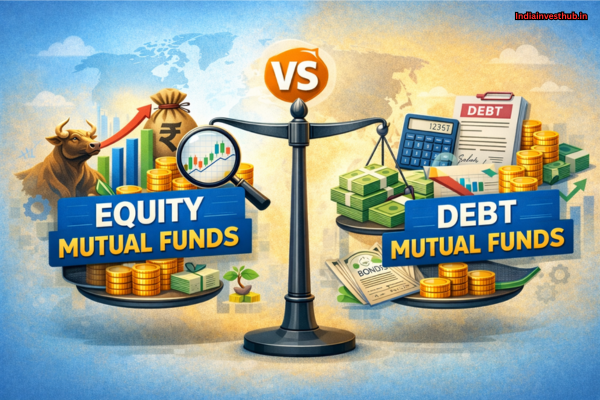
Equity vs Debt Mutual Funds – Key Differences
| Feature | Equity Mutual Funds | Debt Mutual Funds |
|---|---|---|
| Risk Level | High | Low to Moderate |
| Returns | 12-15% long term average | 6-9% average |
| Volatility | High | Low |
| Investment Horizon | Long Term | Short to Medium Term |
| Ideal For | Wealth Creation | Capital Protection |
| Market Dependency | Stock Market | Interest Rates & Bond Market |
Equity funds depend heavily on stock market performance, while debt funds depend on interest rate cycles and bond yields.
How to Invest in Mutual Funds:
Investing in Equity Mutual Funds:
- Define long-term financial goals such as retirement, child education, or wealth creation.
- Choose fund type based on risk level (Large Cap = safer, Mid/Small Cap = higher growth potential).
- Start with SIP (Systematic Investment Plan) to reduce market timing risk.
- Invest for at least 5–10 years to manage market volatility effectively.
- Diversify across sectors and market capitalizations instead of choosing one single fund.
- Review fund performance once or twice a year, not daily or monthly.
- Increase SIP amount when income grows to maximize compounding benefits.
- Stay invested during market corrections to benefit from long-term growth.
Investing in Debt Mutual Funds:
- Identify short-term or medium-term goals like emergency fund or near-term expenses.
- Select debt fund type based on time horizon (Liquid = very short term, Short Duration = 1–3 years).
- Use lump sum investment when interest rates are stable or expected to fall.
- Focus on high credit quality funds to reduce default risk.
- Use debt funds to balance overall portfolio risk during market volatility.
- Park surplus cash in liquid or ultra-short duration funds instead of savings accounts.
- Monitor interest rate cycles because debt fund returns depend on rate movements.
- Rebalance portfolio yearly by shifting profits from equity to debt if needed.
FAQs – Equity vs Debt Mutual Funds
Q1: Which Mutual Funds are safer?
👉Debt Mutual Funds are generally safer because they invest in fixed income instruments.
Q2: Which Mutual Funds give higher returns?
👉Equity Mutual Funds typically give higher returns over long periods.
Q3: Can I invest in both?
👉Yes, combining both helps balance risk and return.
Q4: Are Mutual Funds good for beginners?
👉Yes, especially SIP-based investments in diversified funds.
Q5: Do Mutual Funds guarantee returns?
👉No, Mutual Funds are market-linked investments.
Conclusion:
So, Which Mutual Funds Should You Choose?
- If you want high long-term wealth creation → Choose Equity Mutual Funds
- If you want stable and predictable returns → Choose Debt Mutual Funds
- If you want balanced risk and growth → Choose Both Equity and Debt Mutual Funds
- If you are young and can take risk → More Equity Allocation
- If you are close to financial goals → More Debt Allocation
Mutual Funds are not about choosing one category blindly but about choosing the right mix based on your life stage, financial goals, and risk tolerance.
So, Which Mutual Funds should you choose for your financial journey today?