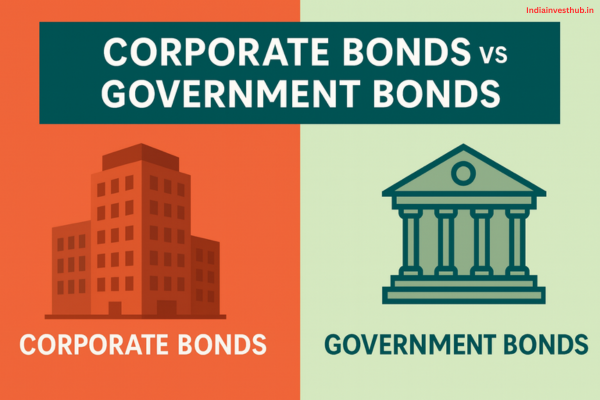
When it comes to building a safe and balanced investment portfolio, bonds often play a crucial role. But choosing the right type of bond can be confusing—especially when the two most popular options, corporate bonds and government bonds, seem similar on the surface. Both offer fixed interest payments, both help diversify risk, and both are widely used by investors who want steady returns. However, they differ significantly in terms of risk, safety, returns, taxation, and who should invest in them.
Understanding these differences can help you decide which bond aligns better with your financial goals. Whether you’re aiming for higher returns, long-term stability, or safe income with minimal risk, comparing corporate and government bonds side by side is the smartest first step.
In this guide, we break down every key point—making it easier for beginners and experienced investors alike to choose the right bond for their needs.
Table of Contents
1) What Are Corporate Bonds?

Corporate bonds are debt securities issued by companies when they need money for expansion, new projects, operations, or debt refinancing. Instead of borrowing from banks, companies borrow from the public by selling these bonds. When you buy a corporate bond, you are essentially lending money to the company, and in return, the company promises to:
- Pay you regular interest (called the coupon rate)
- Return your principal amount at the end of the bond period (maturity)
Corporate bonds are popular among investors who want higher returns than traditional fixed deposits or government bonds.
Key Features of Corporate Bonds:
- Issued by companies (private or public)
- Higher returns because the risk is higher than government bonds
- Credit ratings (AAA, AA, A, etc.) indicate safety
- Fixed interest payouts — monthly, quarterly, or yearly
- Traded in the market, offering liquidity
Types of Corporate Bonds:
- Secured Bonds: Backed by company assets, offering higher safety.
- Unsecured Bonds (Debentures): Not backed by assets; slightly riskier but offer better returns.
- Fixed-Rate Bonds: Pay a constant interest rate throughout the bond tenure.
- Floating-Rate Bonds: Interest varies based on market rates or benchmarks.
- Callable Bonds: Companies can redeem them before maturity.
- Puttable Bonds: Investors can sell back to the issuer before maturity.
- Convertible Bonds: Can be converted into company shares.
- Zero-Coupon Bonds: Issued at a discount and pay no periodic interest.
Advantages of Corporate Bonds:
- Higher Returns: Offers better interest rates than government bonds.
- Regular Income: Provides predictable coupon payments.
- Diversification: Helps balance equity-heavy portfolios.
- Variety: Available in different maturities and risk levels.
Disadvantages of Corporate Bonds:
- Credit Risk: Company may default on interest or principal.
- Market Risk: Bond prices fluctuate with interest rate changes.
- Lower Safety: Not backed by the government.
- Liquidity Issues: Some corporate bonds may be harder to sell quickly.
Why Investors Prefer Corporate Bonds:
Investors choose them because they offer:
- Better interest rates
- Predictable income
- Portfolio diversification
- Access to high-quality corporate debt
2) What Are Government Bonds?

Government bonds are debt instruments issued by a country’s government to raise money for public spending—such as infrastructure, welfare programs, defence, or development projects. When you buy a government bond, you are lending money to the government, and in return, the government promises to:
- Pay you fixed interest at regular intervals
- Return your principal amount on the maturity date
These bonds are considered one of the safest investment options, especially in countries like India, because they are backed by the sovereign guarantee of the government.
Key Features of Government Bonds:
- Issued by the central or state government
- Very low risk, backed by sovereign assurance
- Predictable interest income
- Longer tenures (5–40 years)
- Highly liquid, traded actively in financial markets
Types of Government Bonds:
- Fixed-Rate Bonds: Offer a constant interest rate throughout the tenure.
- Floating-Rate Bonds (FRBs): Interest rate changes periodically based on market conditions.
- Zero-Coupon Bonds: Issued at a discount and pay no periodic interest.
- Sovereign Gold Bonds (SGBs): Linked to the price of gold and offer additional interest.
- Treasury Bills (T-Bills): Short-term bonds with maturities of 91, 182, or 364 days.
- State Development Loans (SDLs): Bonds issued by state governments.
- Inflation-Indexed Bonds: Returns adjust according to inflation levels.
Advantages of Government Bonds:
- High Safety: Backed by the government, making them low-risk.
- Stable Returns: Provide predictable interest income.
- Portfolio Diversification: Ideal for balancing riskier assets.
- High Liquidity: Easy to buy and sell in the market.
- Tax Benefits: Some bonds offer tax exemptions.
Disadvantages of Government Bonds:
- Lower Returns: Offer less interest compared to corporate bonds.
- Long Lock-In: Many bonds have long maturity periods.
- Interest Rate Risk: Prices fall when market interest rates rise.
- Limited Growth: Not suitable for high-return seekers.
Why Investors Prefer Government Bonds:
- Ideal for risk-averse investors
- Suitable for long-term stable income
- Helps diversify portfolios with secure assets
Corporate Bonds vs Government Bonds – Comparison Table
Feature | Corporate Bonds | Government Bonds |
|---|---|---|
Image | | |
Issuer | Private or public companies | Central or state government |
Risk Level | Medium to high | Very low |
Returns | Higher interest rates | Lower but stable returns |
Safety | Depends on company rating | Backed by sovereign guarantee |
Liquidity | Moderate | High |
Ideal For | Investors seeking higher returns | Risk-averse, income-focused investors |
Default Risk | Possible if company fails | Almost zero |
Tenure | Short to long-term | Medium to long-term |
Factors to Consider When Choosing Between Corporate and Government Bonds:
- Risk Tolerance:
Choose government bonds if you prefer safety; opt for corporate bonds if you can handle moderate-to-high risk for better returns. - Return Expectations:
Corporate bonds generally offer higher interest rates, while government bonds provide stable but lower returns. - Investment Horizon:
Government bonds suit long-term goals; corporate bonds offer both short- and long-term options. - Credit Ratings:
Check ratings (AAA, AA, A). Higher-rated corporate bonds are safer but may give lower returns. - Liquidity Needs:
Government bonds are easier to buy/sell; some corporate bonds may have lower liquidity. - Tax Considerations:
Some government bonds offer tax benefits; corporate bond interest is fully taxable. - Economic Conditions:
During uncertainty, government bonds perform better; corporate bond performance depends on company stability.
Conclusion:
Corporate bonds and government bonds both play an important role in building a balanced investment portfolio, but the right choice depends entirely on your financial goals and comfort with risk. If you want higher returns and can handle moderate risk, corporate bonds may fit your strategy. If your priority is safety, stability, and guaranteed income, government bonds are the better option.
Ultimately, a smart investor often uses a mix of both to achieve growth and security. Now that you understand the differences, advantages, and key factors—which type of bond will you choose for your investment journey?