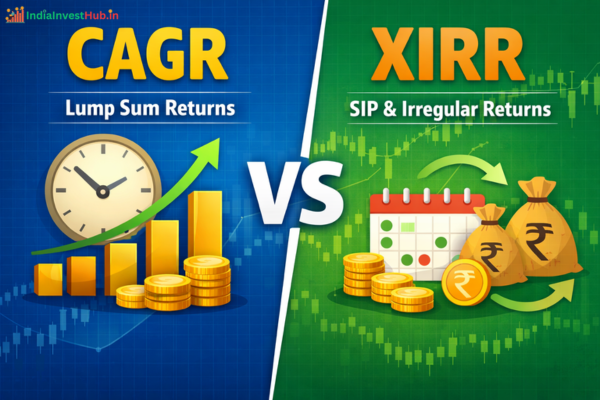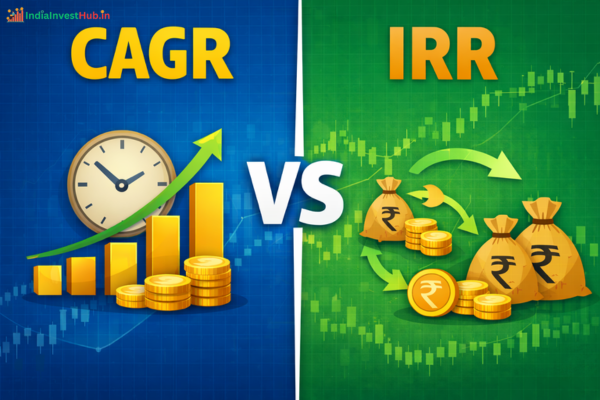
CAGR vs IRR is a comparison many investors eventually face when trying to measure investment performance accurately. At first, returns seem simple—invest money, check profit, calculate percentage. But once you dive deeper into annualized returns and long-term projections, the method you choose can completely change the interpretation of results. Some investors see CAGR in stock performance reports, while corporate finance professionals rely heavily on IRR for evaluating projects. So which return metric is actually more accurate? That depends entirely on the structure of your investment.
According to Investopedia, IRR is the discount rate that makes the net present value (NPV) of all cash flows equal to zero, while CAGR represents the mean annual growth rate of an investment over a specified time period assuming compounding. Both metrics consider the time value of money, but they are used in different scenarios. Understanding how CAGR and IRR work helps investors avoid confusion and evaluate performance correctly.
Let’s break this down clearly and help you decide which return metric is more accurate for your needs.
1) What is CAGR (Compound Annual Growth Rate)?
CAGR (Compound Annual Growth Rate) measures the average annual growth rate of an investment over a specific period, assuming the growth happens steadily and profits are reinvested.
CAGR answers one simple question:
“If my investment grew at a constant rate every year, what would that rate be?”
For example:
- Initial investment: ₹1,00,000
- Final value after 5 years: ₹2,00,000
CAGR smooths volatility and gives a single annual percentage return.
CAGR Formula:
CAGR = (Ending Value / Beginning Value)^(1 / Number of Years) − 1
If you apply the formula:
CAGR = (200000 / 100000)^(1/5) − 1 ≈ 14.87%
That means the investment grew at 14.87% annually.
Benefits of CAGR:
- Simple and easy to calculate
- Ideal for lump sum investments
- Useful for long-term index analysis
- Smooths yearly volatility
- Easy comparison between assets
Stock market indices often report long-term performance using CAGR. For example, historical data from National Stock Exchange of India indicates that Indian equity markets have delivered around 12–15% annualized returns over long periods, typically expressed as CAGR.
Limitations of CAGR:
- Assumes steady growth
- Ignores volatility within the period
- Not suitable for multiple cash flows
- Cannot handle staggered investments
CAGR works best when there is one investment and one ending value.
2) What is IRR (Internal Rate of Return)?
IRR (Internal Rate of Return) calculates the annualized return that makes the net present value of future cash flows equal to zero. Unlike CAGR, IRR accounts for multiple future cash inflows and outflows.
IRR is widely used in:
- Capital budgeting
- Startup evaluation
- Real estate investments
- Project analysis
Financial institutions and analysts use IRR to determine whether a project meets required return thresholds.
IRR Formula:
0 = Σ [ Cash Flowₜ ÷ (1 + IRR)ᵗ ]
Where:
- Cash Flowₜ = Cash flow at time t
- IRR = Discount rate
- t = Time period
Because solving this equation manually is complex, investors typically use Excel:
=IRR(values)
Benefits of IRR:
- Considers time value of money
- Accounts for multiple cash flows
- Useful in project evaluation
- Widely accepted in corporate finance
- Helps compare profitability across projects
IRR gives a more dynamic return calculation compared to CAGR in scenarios with varying cash flows.
Limitations of IRR:
- Assumes reinvestment at same rate
- Can produce multiple IRRs in complex cases
- Sensitive to timing of cash flows
- Harder to calculate manually
- May not reflect scale of investment
CAGR vs IRR: Key Differences
| Feature | CAGR | IRR |
|---|---|---|
| Investment Type | Single Lump Sum | Multiple Cash Flows |
| Complexity | Simple | Moderate to Complex |
| Time Value of Money | Yes | Yes |
| Best Used For | Stock buy-and-hold | Business projects |
| Volatility Handling | Smoothed | Based on cash flow timing |
The core difference is this:
CAGR measures growth between two points in time.
IRR evaluates a stream of cash flows over time.
Is IRR More Accurate Than CAGR?
The answer depends on context.
If you invest ₹1,00,000 once and hold for 10 years, CAGR is accurate and sufficient.
If you invest additional money every year or receive periodic returns, IRR becomes more accurate because it considers each cash flow separately.
In capital budgeting, IRR is often preferred because projects involve multiple cash flows. According to financial education research by Corporate Finance Institute, IRR is a core metric in evaluating corporate investments.
For retail investors:
- Lump sum → CAGR is accurate
- Business project → IRR is accurate
So IRR is not always “more accurate.” It is more appropriate when multiple cash flows exist.
When Should You Use CAGR?
Use CAGR when:
- You make one lump sum investment
- You compare long-term stock growth
- You analyze index performance
- There are no intermediate cash flows
CAGR is ideal for buy-and-hold strategies.
When Should You Use IRR?
Use IRR when:
- You analyze business projects
- You invest in startups
- You evaluate real estate deals
- There are periodic cash inflows
- You want to compare multiple investment opportunities
IRR gives a deeper evaluation for structured financial decisions.
FAQs – CAGR vs IRR
Q1: Is IRR always higher than CAGR?
👉Not necessarily. They measure different scenarios.
Q2: Can CAGR and IRR be the same?
👉Yes, if there is a single investment and single exit.
Q3: Is IRR better for mutual funds?
👉For multiple cash flows, XIRR is better.
Q4: Is CAGR easier to understand?
👉Yes, CAGR is simpler.
Q5: Which metric do professionals use?
👉Corporate finance professionals frequently use IRR.
Q6: Is CAGR suitable for SIP investments?
👉No. CAGR is not ideal for SIPs because investments are made at different times. XIRR is better in that case.
Conclusion:
IRR vs CAGR is not about which metric is universally better, but which one fits your investment structure. CAGR is simple, reliable, and ideal for lump sum, long-term investments. IRR is powerful, dynamic, and essential for evaluating projects and investments involving multiple cash flows. Both metrics consider the time value of money, but they serve different purposes.
Understanding when to use CAGR and when to use IRR ensures you measure performance correctly and avoid misleading conclusions. Instead of asking which return metric is superior, the better question might be: are you using the right return metric for your specific investment strategy?