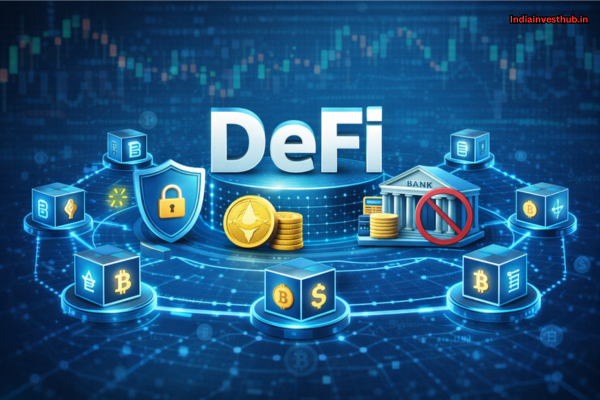
Decentralized Finance, or DeFi, is rewiring the global financial system in a way that finally gives more control to everyday people and small businesses — not just banks and large institutions. Built on blockchain technology, DeFi removes traditional middlemen from financial services like lending, borrowing, saving, payments, and investing. That means anyone with an internet connection can access financial tools that were once limited by geography, bank approval, or high fees.
For individuals, DeFi opens doors to earning passive income, accessing global lending markets, and securely storing value — even in countries where banking systems are unstable or inaccessible. For small businesses, it offers faster payments, lower transaction costs, easier access to capital, and new ways to raise funds through tokenization and peer-to-peer lending. This shift is especially powerful in developing regions, where millions remain underbanked or excluded from traditional finance.
Of course, DeFi also comes with risks — from volatility and scams to regulatory uncertainty — which means awareness and responsible use are essential. But as innovation continues, DeFi is proving to be more than a buzzword. It’s becoming a real financial lifeline, empowering people and small businesses worldwide to take control of their money, grow wealth, and participate in a truly open financial economy.
Table of Contents
What Is DeFi? Understanding the Basics of Decentralized Finance
DeFi — short for decentralized finance — refers to financial services built on blockchain networks like Ethereum, Solana, and others. These applications replace traditional financial intermediaries like banks, brokers, and payment processors with smart contracts — automated, self-executing code that enforces rules and transactions without the need for a third party.
The key characteristics of DeFi include:
- Open accessibility: Anyone with a digital wallet and internet access can participate.
- Transparency: Network activity and rules are visible on public ledgers.
- Permissionless innovation: Developers can build new services without regulatory barriers or gatekeepers.
For investors, DeFi represents a paradigm shift — one that moves financial power away from centralized institutions and toward decentralized networks where individuals control their own assets and access services directly.
What Is Cryptocurrency? A Beginner’s Guide to Digital Money and How It Works
Financial Inclusion: How DeFi Gives Access to the Unbanked and Underbanked
One of the most compelling aspects of DeFi is its potential to bring financial services to the unbanked and underbanked. According to the World Bank, about 1.4 billion adults worldwide did not have access to formal financial services as of 2024 — a population that stands to benefit greatly from decentralized platforms.
DeFi protocols require no traditional bank account, credit history, or geographic verification, allowing individuals in developing regions to:
- Save and earn interest on digital assets
- Borrow against crypto collateral
- Transfer funds without hefty fees or intermediaries
For example, someone in a region where bank accounts are hard to obtain can use DeFi lending platforms to secure loans or earn yield on savings — opportunities often unavailable through local banks. For investors, this growth reflects not only a social impact narrative but also the expansion of potential users and capital inflows into DeFi ecosystems.
Lower Fees and Faster Transactions: Why DeFi Is Cost-Effective for Small Businesses
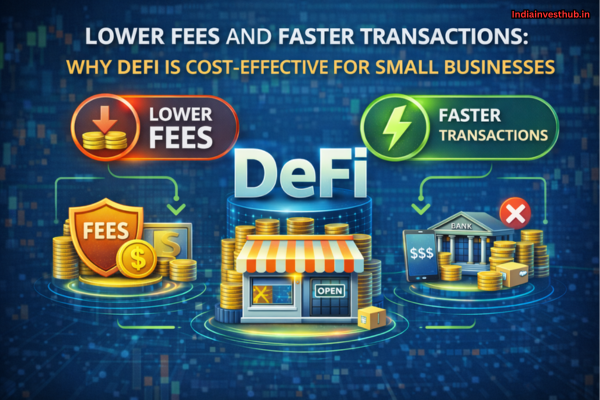
Traditional financial services often impose significant fees for payments, transfers, and foreign exchange. These costs can eat into the thin margins of small businesses operating locally or internationally. DeFi platforms, however, often execute transactions at a fraction of the cost and without centralized processing delays.
For example, sending funds through decentralized networks can be much cheaper than using traditional correspondent banking, especially for cross-border payments, where banks and remitters typically charge several percent of the transfer value. DeFi users often pay just a network transaction fee (gas), which can be lower depending on the blockchain and network congestion.
This cost efficiency is particularly impactful for small businesses that rely on frequent payments or operate in markets where bank fees are high and access to credit is limited. For investors, the cost savings realized by businesses using DeFi signals wider adoption and growing utility beyond speculative trading.
Peer-to-Peer Lending: How Borrowers Access Capital Without Banks
One of the transformative use cases for DeFi lies in peer-to-peer lending. Traditional loans usually require credit history, collateral, and intermediaries — requirements that frequently leave small business owners and individuals underserved. DeFi lending protocols such as Aave, Compound, and MakerDAO allow users to lend or borrow directly with digital assets, often using crypto as collateral, transparent interest rates, and automated processes.
In traditional finance, borrowers might wait days or weeks for loan approval. In DeFi, loans can be originated in minutes — and because smart contracts manage the terms, trust is less of a concern. This democratized access to capital empowers entrepreneurs to fund their operations or expand without navigating restrictive bank criteria.
For investors, DeFi lending platforms offer opportunities to earn interest by providing liquidity, thereby tapping into the growth of decentralized credit markets.
Earning Passive Income Through Staking, Liquidity Pools, and Yield Farming:
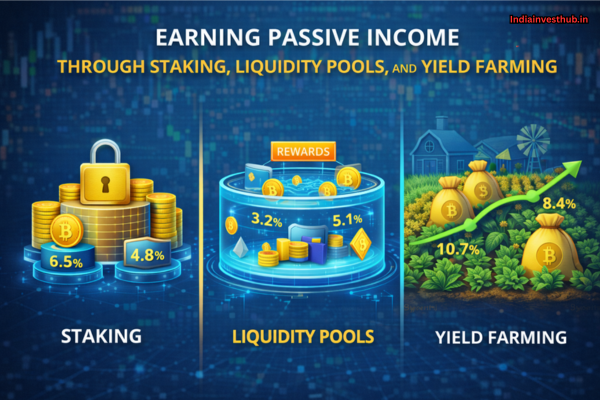
DeFi opened doors to passive income opportunities that are distinct from traditional interest-bearing accounts or dividend-paying stocks. Investors and users can generate returns through:
- Staking: Locking tokens to support network consensus in proof-of-stake systems.
- Liquidity Pools: Providing assets to DeFi exchanges and earning a share of transaction fees.
- Yield Farming: Strategically moving assets across protocols to maximize returns.
While these strategies carry risks — including impermanent loss, smart contract vulnerabilities, and fluctuating yields — they have attracted investors seeking returns beyond what traditional savings or investment products deliver.
In addition to individual investors, small businesses can use these strategies to grow treasury holdings or generate supplementary income streams, further demonstrating DeFi’s multifaceted financial utility.
Smart Contracts: Automating Business Agreements Securely and Transparently
Smart contracts are at the heart of DeFi innovation. These programmable agreements automatically execute transactions when predefined conditions are met — reducing the need for intermediaries and lowering administrative costs.
For example, small businesses can use smart contracts to automate supplier payments, escrow arrangements, or even customer loyalty rewards without manual oversight. The automation reduces overhead, minimizes human error, and increases transparency — all while executing terms exactly as coded.
For investors, adoption of smart contract-based systems signals that DeFi is not just a speculative playground but a functional toolkit for enterprise efficiency.
Tokenization: Turning Real-World and Business Assets Into Digital Investments
DeFi also enables the tokenization of real-world assets — converting ownership rights into digital tokens on a blockchain. This process unlocks new liquidity for traditionally illiquid assets such as:
- Real estate
- Fine art
- Business revenue streams
- Intellectual property
Tokenization allows fractional ownership, meaning smaller investors can own portions of high-value assets without large capital requirements. For small businesses, tokenization can serve as an innovative fundraising method, creating new investment avenues and expanding capital reach.
For investors, tokenized assets represent a bridge between traditional markets and next-generation finance tools — opening diversified opportunities in digital and real-world asset classes.
Stablecoins: A Safer On-Ramp for Everyday Transactions
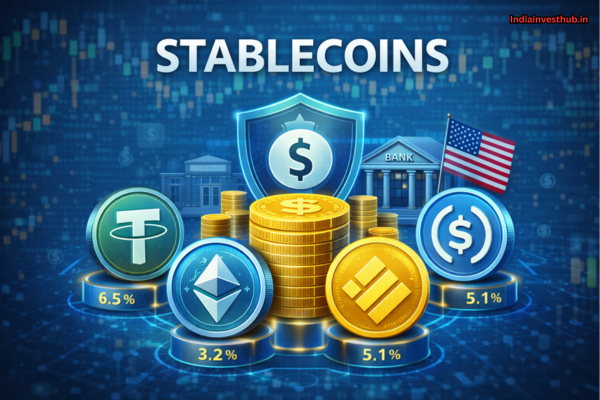
Stablecoins — cryptocurrencies pegged to stable assets like the U.S. dollar — play a critical role in DeFi ecosystems. Because they reduce exposure to volatility, stablecoins serve as a reliable medium for day-to-day transactions, payroll, savings, and cross-border payments.
In markets with volatile local currencies or limited bank access, stablecoins offer predictable value storage and quick settlement. For small businesses operating internationally, this reduces currency conversion costs and simplifies bookkeeping.
For investors, stablecoins represent a gateway into DeFi, providing liquidity and reducing volatility while maintaining access to decentralized services.
Risk Factors in DeFi — And How Users Can Stay Safe:
While the advantages of DeFi are significant, investors should approach this space with awareness of risks:
- Smart contract bugs: Code vulnerabilities can lead to loss of funds.
- Impermanent loss: Providing liquidity may result in losses relative to holding assets.
- Regulatory uncertainty: DeFi operates in a grey area in many jurisdictions.
- Market volatility: Prices of DeFi tokens can swing dramatically.
To stay safe, users are encouraged to:
- Perform due diligence on protocols
- Use audited and well-reviewed smart contracts
- Diversify positions and avoid putting all capital into a single protocol
Understanding risks is as important as recognizing the benefits, especially for investors seeking sustainable exposure.
The Future of DeFi: How Regulation and Innovation Will Shape Financial Empowerment
Regulatory clarity is one of the biggest factors that will influence DeFi’s future. Governments and financial authorities are beginning to craft rules that impact decentralized markets — from tax reporting to operational compliance. While some see regulation as a threat, others argue that clear rules will enable broader institutional participation and greater investor protection.
Innovation will also continue, with breakthroughs in cross-chain interoperability, privacy-enhancing technologies, and Layer-2 scaling solutions that make DeFi faster and more cost-effective.
For investors who want to know How DeFi is Empowering Individuals and Small Businesses Worldwide, these developments could signal a transition from early adopter terrain to mainstream financial infrastructure.
FAQs — DeFi
Q1: What is DeFi?
👉DeFi stands for decentralized finance — financial services built on blockchain networks without centralized intermediaries.
Q2: How does DeFi help small businesses?
👉DeFi provides faster transactions, peer-to-peer lending, lower fees, and new income streams through liquidity provision and yield farming.
Q3: Are DeFi investments risky?
👉Yes, risks include smart contract vulnerabilities, regulatory uncertainty, and market volatility. Proper research and diversification help mitigate risk.
Q4: Can DeFi help the unbanked?
👉Yes. Because DeFi only requires internet access and a wallet, it can bring financial tools to those without traditional bank access.
Q5: What role do stablecoins play in DeFi?
👉Stablecoins reduce price volatility and serve as a reliable medium for everyday transactions and treasury functions.
Conclusion:
DeFi is no longer just a buzzword — it’s an operational financial system that empowers individuals and small businesses by improving access to capital, lowering costs, enabling passive income, and fostering economic inclusion. For investors seeking growth opportunities beyond traditional finance, DeFi represents a frontier where innovation, financial utility, and accessibility intersect.
As this ecosystem matures — driven by technological development and eventually clearer regulation — the potential to reshape how financial services are delivered continues to grow. For investors ready to participate in that transformation, the real question isn’t just whether DeFi can change the world — but how will you position yourself to benefit from its expanding impact?