Mutual Funds — for many investors planning retirement, one of the most common questions is: How many mutual funds should you include in a retirement portfolio? The answer isn’t a flat number, but it does matter significantly for your long-term outcome. Studies show that a modest number of well-selected funds can reduce risk and simplify management, while piling into too many schemes may dilute returns and increase complexity. For example, research found that “portfolios with as few as four growth funds halve the dispersion in terminal-period wealth for 5- to 19-year holding periods.”
Meanwhile, modern commentary from India suggests that for most investors aiming for effective diversification, “3 to 5 mutual funds are enough to create a strong, goal-aligned portfolio” and that “a portfolio with 15 overlapping funds isn’t diversified, it’s just over-complicated.”
Why the Number of Mutual Funds Matters in a Retirement Portfolio:
When you’re building a retirement account, you’re not just chasing returns — you’re balancing growth, risk, stability and manageability. Including too few funds may leave you vulnerable to the underperformance of a single fund or fund manager. On the other hand, too many funds can blur your strategy, create overlap (for example two equity funds holding many of the same stocks), and inflate costs. The key is finding the number where you get meaningful diversification without losing clarity.
For retirement, your time horizon, risk profile, and asset allocation all come into play. Research from the U.S. shows that even just four well-chosen funds can significantly reduce risk for fixed-horizon goals like retirement. In the Indian context, a guide by an asset-management firm suggests a rule of thumb of around 12-15 funds, considering different fund types (equity, debt, hybrid etc.). So the number isn’t universal — it depends on how many categories you’re covering and how much overlap there is between funds.
Ideal Number of Mutual Funds for Beginners Planning Retirement:
If you’re at the early stage of retirement planning and you want simplicity, a good starting guideline might be: choose about 4-6 funds that cover your major buckets (equity, debt/hybrid, maybe international or thematic). The research supports that this range gives you meaningful diversification without over-complication.
For example:
- One large-cap equity fund
- One mid/small cap or diversified equity fund
- One debt or income fund
- One hybrid or balanced fund for stability
- Possibly one international or thematic fund (if you’re willing and knowledgeable)
This gives you exposure to growth, stability, and diversification across asset types. As you grow in experience or accumulate more assets, you might expand to cover more niche categories — but only if you can keep track and avoid duplication.
How to Decide the Right Number of Mutual Funds Based on Risk Profile:
Your personal risk tolerance and retirement horizon should influence how many funds you hold. If you’re younger and comfortable with higher risk, you may tolerate more equity-oriented funds; if you’re nearing retirement or prefer stability, you’ll lean more toward debt or hybrid funds and fewer high-risk equity schemes.
- High risk / long horizon → You might hold 5-8 mutual funds: more equity funds, maybe thematic or small cap.
- Moderate risk / medium horizon → Perhaps 4-6 funds, split between equity, debt/hybrid.
- Low risk / close to retirement → Maybe 3-5 mutual funds, mostly debt/hybrid with minimal equity.
The number remains manageable while reflecting your risk profile. Also remember: it’s not just about count, but about how distinct each fund is in strategy and holdings.
Equity vs Debt Funds: How Many of Each Should You Hold for Retirement?
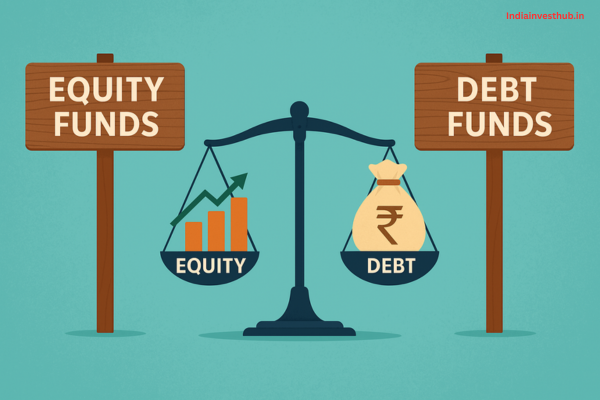
Within your fund count, you also need to think about how many equity funds and how many debt (or hybrid) funds. For instance, a simplified retirement portfolio might have two equity funds and one debt/hybrid fund if you’re at a moderate risk level. If you’re higher risk, maybe three equity funds and one debt/hybrid. If you’re more conservative: one equity, two debt/hybrid.
The key is to ensure your total fund count doesn’t balloon simply because you hold many tiny niche funds each within equity or debt. The objective is strategic exposure, not quantity. For example, the Indian guidance of 12-15 total funds includes 7 equity + 4 debt + 1 gold ETF + 1 multi-asset fund as a maximum for many investors. So you might structure something like:
- Equity funds: 2-4
- Debt/hybrid funds: 1-2
- Optional: 1 international or thematic fund (if space and understanding permit)
This keeps things balanced and avoid overloading your portfolio with many minor variations.
Is Holding Too Many Mutual Funds Bad for Your Retirement Plan?
Yes — it can be. Holding too many mutual funds can lead to excessive overlap where multiple funds hold the same underlying stocks or bonds. This reduces the benefit of diversification. One commentary noted: “a portfolio with 15 overlapping funds isn’t diversified, it’s just over-complicated.”
Other risks of too many funds for a retirement portfolio:
- Harder to track and rebalance each fund
- Higher combined fees and expense ratios
- Diminishing marginal diversification benefit once you’ve covered key asset classes
- Increased psychological burden — more decisions, more confusion
So yes, more isn’t always better. The goal is effective diversification rather than fund count diversification.
Best Combination of Mutual Fund Types for a Strong Retirement Portfolio:
Putting it all together, here’s a sample fund combination for a retirement-oriented portfolio (assuming moderate risk appetite):
- Large-cap equity fund
- Mid/small-cap or diversified equity fund
- Debt income fund (or short/medium term debt)
- Hybrid/balanced fund (equity + debt)
- International equity or thematic fund (optional)
If you keep it to 4-5 mutual funds initially, you’re covering growth, stability, diversification and optional global exposure. Later you might expand to one or two additional funds (e.g., a small-cap only fund or a gold ETF) if your risk profile and monitoring capacity allow. The key: each fund should serve a distinct role, not replicate another.
How Time Horizon Affects the Number of Mutual Funds You Need:
Your horizon — the time you have until you’ll start using the retirement corpus — plays a vital role in determining how many mutual funds you need and which types. If you’re 25 years away from retirement, you have time to absorb risk and can afford a few more equity funds and maybe thematic ones. But if you’re 5 years away, you want simplicity, fewer funds, and more debt/hybrid exposure.
Research on fixed-horizon goals (like retirement) shows that diversification benefits increase with horizon length and that holding multiple funds reduces variation in outcomes. Therefore:
- Long horizon → More funds (but still manageable), more equity
- Short horizon → Fewer funds, simpler structure, more focus on debt/hybrid
How to Avoid Fund Duplication and Portfolio Overlap:
Avoiding overlap is critical. You might have five funds, but if three of them invest heavily in the same stocks or the same sector, your effective diversification is much lower. To avoid duplication:
- Check the top 10 holdings of each fund – if there’s high overlap, reconsider
- Review the investment style: large-cap vs. mid-cap vs. small-cap; sector vs. diversified
- Ensure your equity, debt and hybrid funds cover different asset classes or strategies
- Use an index fund or passive fund in one slot — which helps cover broad market exposure without overlaps
Over-lap defeats the purpose of holding multiple funds. The research notes that “diversification may even increase systemic risk when funds diversify in the same way.” Good portfolio building means varied exposure, not more of the same.
Role of Index Funds in Reducing the Number of Mutual Funds Required:
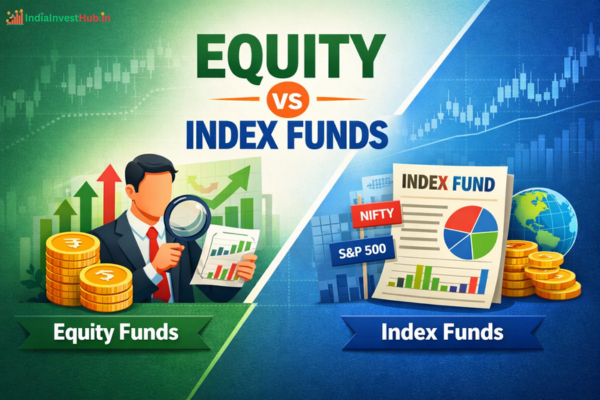
Index funds (or passive funds) can be powerful in a retirement portfolio. Because they often cover broad market segments at low cost, they can serve as one of your fewer funds yet give you wide market exposure. For example, instead of three different active large-cap funds, you might pick one low-cost index fund and one active fund, reducing overlap and complexity.
Using an index fund helps you:
- Lower costs (expense ratio tends to be lower)
- Reduce fund-manager risk (less dependent on active selection)
- Simplify your portfolio structure
Thus, by including a high-quality index fund, you might safely keep your total number of mutual funds on the lower end (e.g., 3-5) while still covering broad exposure.
How Often Should You Review and Adjust Your Retirement Mutual Fund Count?
Creating your portfolio and picking your funds is only half the job. Periodic review is key — especially as your retirement horizon shortens or your life circumstances change. Some pointers:
- Review annually: check performance, holdings overlap, fund strategy changes
- Review when you cross a major life milestone: e.g., you’re 10 years away vs. 5 years away from retirement
- If you add a new fund, consider whether it duplicates existing exposure or truly adds something new
- If you reduce risk (e.g., shifting more into debt), it may make sense to reduce total fund count and simplify
In short: adjust your fund count and mix as your strategy evolves, rather than set it and forget it.
FAQs – Retirement Portfolio
Q1: Can I just pick one mutual fund and be done?
👉Yes, it’s possible — especially if you pick a broad-based balanced fund or target-maturity fund. But holding just one fund means you’re dependent on that fund’s manager, strategy and risk profile. Having two or three funds gives you a safety net.
Q2: Is there a “magic number” of funds I must hold?
👉No. The “right” number depends on your risk profile, horizon and the distinct strategies of the funds you choose. But most research points to 3-10 being appropriate for many investors.
Q3: If I already have 10 mutual funds, should I reduce?
👉You might consider reviewing: are those funds overlapping? Are they well-distinct? If many are similar (same cap size, same sector), consolidation might improve your portfolio.
Q4: Should I adjust the number of funds as I near retirement?
👉Yes. As you approach retirement, simplifying your portfolio — fewer funds, more stability, less overlap — becomes increasingly important.
Q5: Does the number of mutual funds matter more than asset allocation (equity vs debt)?
👉No — asset allocation remains the most important determinant of performance and risk. The number of funds matters because it affects how well that allocation is implemented and how well diversification is achieved.
Conclusion:
Mutual Funds are a powerful tool in building a retirement portfolio, and the number you include plays a meaningful role. Too few might expose you to fund-specific risks; too many can lead to complexity, overlap and diluted returns. For most investors, starting with around 4-6 well-chosen mutual funds (covering equity, debt/hybrid and possibly international exposure) makes sense, and then adjusting as you get closer to retirement.
Your ideal number depends on your risk tolerance, time horizon and how distinct each fund is. The key is not simply the count, but the quality and differentiation of each fund within your retirement plan.
So, how many mutual funds will you include in your retirement portfolio?