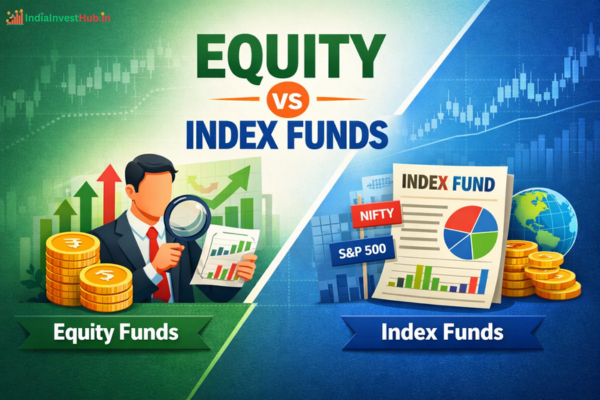
Index Funds and Equity mutual funds are two of the most popular investment choices for investors who want long-term wealth creation, but deciding between them can feel confusing when both appear to offer strong growth potential. Many investors reach a point where they ask the same question: Which fund actually suits my goals better? The answer depends on factors such as risk tolerance, investment strategy, and how actively you want your money managed.
Over the past decade, the Indian mutual fund industry has grown significantly, reaching over ₹57 trillion in assets under management as of 2025 according to the Association of Mutual Funds in India (AMFI). During this growth, investors have increasingly explored both actively managed equity funds and passive options like index funds.
In fact, a report from Morningstar India highlights that passive funds, including index funds and ETFs, have been growing rapidly as investors look for lower-cost alternatives to traditional funds. Understanding the difference between these two options helps investors choose investments that match their financial goals, whether the aim is long-term growth, diversification, or cost efficiency.
1) What Are Equity Mutual Funds?

Equity mutual funds are investment funds that primarily invest in stocks of publicly traded companies. A professional fund manager selects and manages a portfolio of stocks with the goal of outperforming the market or a benchmark index. Investors buy units of the fund, and their money is pooled with other investors to create a diversified portfolio.
Equity funds are considered actively managed funds, meaning the fund manager continuously analyzes market trends, company performance, and economic conditions to decide which stocks to buy or sell.
According to SEBI (Securities and Exchange Board of India) regulations, equity mutual funds must invest at least 65% of their assets in equities and equity-related instruments to qualify for equity taxation benefits.
For investors, equity funds offer an opportunity to participate in the stock market without needing to research and manage individual stocks themselves.
Types of Equity Mutual Funds:
Equity mutual funds come in different categories depending on market capitalization, investment strategy, and sector focus.
1. Large Cap Funds
These funds invest primarily in large, well-established companies such as those in the Nifty 50 or Sensex. Large cap funds tend to be relatively stable compared with mid or small cap funds.
2. Mid Cap Funds
Mid cap funds invest in medium-sized companies with strong growth potential. These funds often provide higher returns but may also involve higher risk.
3. Small Cap Funds
Small cap funds focus on smaller companies that may grow rapidly over time. While these funds can generate significant returns, they also carry greater volatility.
4. Sectoral or Thematic Funds
These funds invest in specific industries such as technology, banking, or pharmaceuticals. Their performance depends heavily on the growth of the chosen sector.
5. Multi Cap or Flexi Cap Funds
These funds invest across large, mid, and small cap companies, offering diversification across different market segments.
Benefits of Equity Mutual Funds:
Equity mutual funds have long been a preferred choice for investors seeking higher returns over the long term.
1. Potential for Higher Returns
Historically, equity markets have delivered strong long-term returns. According to NSE data, the Nifty 50 index has delivered around 12–14% annualized returns over long investment periods, although actual mutual fund returns may vary.
2. Professional Fund Management
Equity funds are managed by experienced fund managers who analyze financial statements, industry trends, and economic indicators.
3. Diversification
Investing in a mutual fund spreads your money across multiple companies and sectors, reducing the risk of relying on a single stock.
4. Systematic Investment Options
Investors can invest through Systematic Investment Plans (SIPs), which allow small monthly investments instead of large lump sums.
5. Tax Efficiency
Equity funds held for more than one year qualify for long-term capital gains tax, which is generally lower compared with short-term taxation.
2) What Are Index Funds?

Index funds are passive mutual funds designed to track the performance of a specific market index such as the Nifty 50 or Sensex. Instead of relying on a fund manager to pick stocks, index funds simply replicate the holdings of the underlying index.
For example, a Nifty 50 index fund will invest in the same 50 companies that make up the Nifty 50 index and maintain similar weightings.
Because index funds follow a predefined strategy, they typically have lower management fees compared with actively managed equity funds.
According to a SPIVA (S&P Indices Versus Active) report, a significant percentage of actively managed funds fail to outperform their benchmark indices over long periods. This finding has contributed to the rising popularity of index funds worldwide.
Types of Index Funds:
Index funds can track different types of market indices.
1. Broad Market Index Funds
These funds track large indices such as the Nifty 50, Sensex, or Nifty 100.
2. Sector Index Funds
Sector index funds track specific industries such as IT, banking, or pharmaceuticals.
3. International Index Funds
These funds track global indices such as the S&P 500, giving investors exposure to international markets.
4. Bond Index Funds
Some index funds track bond indices instead of equities, providing exposure to fixed-income investments.
Benefits of Index Funds:
Index funds have become increasingly popular among investors because of their simplicity and cost efficiency.
1. Low Expense Ratios
Index funds typically have lower management fees because they do not require active stock selection.
2. Transparent Strategy
Investors know exactly which companies the fund holds because it simply tracks a public index.
3. Market-Level Returns
Instead of trying to beat the market, index funds aim to match the market’s performance.
4. Lower Turnover
Since index funds follow a fixed index, they buy and sell stocks less frequently, which reduces transaction costs.
5. Long-Term Simplicity
Many investors prefer index funds for long-term investing because they require minimal monitoring or decision-making.
Equity vs Index Funds – Key Differences
Understanding the core differences between equity mutual funds and index funds helps investors make better investment decisions.
| Feature | Equity Mutual Funds | Index Funds |
|---|---|---|
| Management Style | Actively managed | Passively managed |
| Goal | Beat the market | Match the market |
| Expense Ratio | Usually higher | Generally lower |
| Risk | Depends on strategy | Follows market risk |
| Returns | Can outperform or underperform | Usually close to index returns |
While equity funds aim to outperform benchmark indices, index funds focus on delivering consistent returns aligned with the overall market.
How to Invest in Mutual Funds:
Investing in mutual funds has become easier in recent years thanks to digital platforms and simplified KYC procedures.
1) Investing in Equity Mutual Funds:
Investors can start investing in equity mutual funds by following these steps:
- Complete the KYC process through a mutual fund platform.
- Choose a fund category based on risk tolerance.
- Analyze past performance and expense ratios.
- Decide between lump sum investment or SIP.
- Monitor the fund periodically.
Popular platforms for investing include mutual fund websites, stockbrokers, and investment apps.
2) Investing in Index Funds:
Investing in index funds follows a similar process but usually involves fewer decisions.
- Select the index you want to track, such as Nifty 50 or Sensex.
- Choose a fund with a low expense ratio.
- Start investing through SIP or lump sum.
- Stay invested for the long term.
Many long-term investors prefer index funds because they eliminate the need to constantly evaluate fund managers or strategies.
FAQs – Equity vs Index Funds
Q1: Are index funds safer than equity mutual funds?
👉Index funds are not necessarily safer, but they tend to be more predictable because they track a market index rather than relying on active management.
Q2: Can equity funds beat index funds?
👉Yes, some actively managed equity funds outperform index funds, but many fail to do so consistently over long periods.
Q3: Which fund is better for beginners?
👉Many beginners prefer index funds because they are simple, low cost, and easy to understand.
Q4: Are index funds good for long-term investing?
👉Yes. Many financial experts recommend index funds for long-term wealth building due to their low cost and consistent market exposure.
Q5: Can I invest in both equity and index funds?
👉Yes. Many investors diversify their portfolio by investing in both types of funds.
Conclusion:
So, Which Fund Should You Choose?
- Choose equity mutual funds if you want the possibility of beating market returns and are comfortable with active fund management.
- Choose index funds if you prefer low-cost investing and want returns that match the market.
- Choose equity funds if you are willing to take slightly higher risk for potential outperformance.
- Choose index funds if you prefer simplicity and long-term consistency.
- Choose a combination of both if you want a balanced investment strategy.
Ultimately, the best choice depends on your investment goals, risk tolerance, and time horizon, so which approach aligns best with your financial strategy?