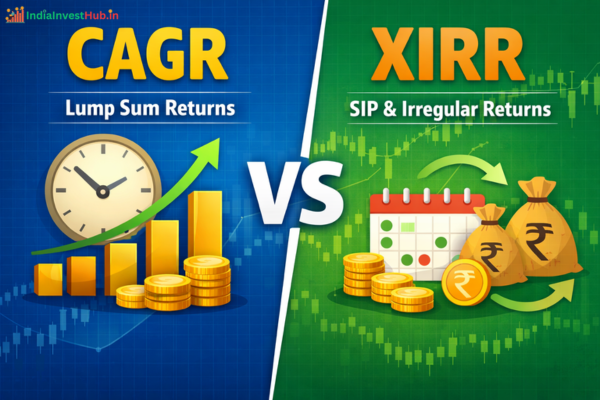
Investors often focus on returns, but the real challenge begins when trying to measure them accurately. That’s where the confusion between CAGR vs XIRR usually starts. Many people see impressive profit numbers in their portfolio, yet when they calculate annual returns, the percentage changes depending on the method used. Some reports highlight CAGR, while mutual fund statements often show XIRR. So which one actually reflects your real performance, and which is better for investors?
The answer depends on how you invest. If you put a lump sum into a stock and hold it for years, CAGR might give you a clear and simple annual growth rate. But if you invest through SIPs or make multiple contributions at different times, XIRR becomes more accurate because it considers every transaction date. According to financial education sources like Investopedia, CAGR measures the average annual growth rate over time, while XIRR is designed for irregular cash flows.
Understanding the difference between CAGR and XIRR is not just about formulas—it’s about evaluating your investments correctly. When you use the right metric, you gain clarity, confidence, and better decision-making power as an investor.
1) What is Compound Annual Growth Rate (CAGR)?

CAGR (Compound Annual Growth Rate) represents the average annual growth rate of an investment over a specific time period, assuming profits are reinvested every year. It smooths out yearly volatility and gives a consistent growth rate.
In simple terms, CAGR answers this:
“If my investment grew at the same rate every year, what would that rate be?”
For example:
- Beginning value = ₹1,00,000
- Ending value after 5 years = ₹2,00,000
CAGR tells you the annual growth rate required to double the investment in five years.
Compound Annual Growth Rate Formula:
CAGR = (Ending Value / Beginning Value)^(1 / Number of Years) − 1
Where:
- Ending Value = Final amount
- Beginning Value = Initial investment
- Number of Years = Investment duration
How to Calculate CAGR:
Step 1: Identify beginning value
Step 2: Identify ending value
Step 3: Identify number of years
Step 4: Apply formula
Example:
CAGR = (200000 / 100000)^(1/5) − 1
CAGR ≈ 14.87%
This means the investment grew at 14.87% annually.
Benefits of CAGR:
- Simple and easy to calculate
- Ideal for lump sum investments
- Smooths market volatility
- Helps compare long-term performance
Historically, Indian equity markets have delivered around 12–15% annualized returns over long periods according to market research data published by major financial platforms. CAGR helps investors understand such long-term performance clearly.
Limitations of CAGR:
- Assumes single investment and single exit
- Ignores multiple cash flows
- Does not show volatility
- Not accurate for SIP investments
CAGR works best when money is invested once and withdrawn once.
2) What is Extended Internal Rate of Return (XIRR)?
XIRR (Extended Internal Rate of Return) calculates annualized returns when investments happen at multiple dates and amounts. It is an advanced version of IRR that handles irregular cash flows.
According to Corporate Finance Institute, XIRR adjusts for different cash flow timings, making it more realistic for modern investing patterns like SIPs.
If you invest ₹5,000 every month through SIP, each installment has a different starting date. XIRR calculates the real annual return considering each transaction separately.
XIRR Formula:
Σ [ Cash Flow ÷ (1 + r)^(Days/365) ] = 0
Where:
- Cash Flow = Investment or withdrawal
- r = XIRR
- Days = Number of days between cash flow and final date
Because solving this manually is complex, Excel is commonly used.
How to Calculate XIRR:
Step 1: Enter all investments as negative values
Step 2: Enter final value as positive
Step 3: Include correct dates
Step 4: Use Excel formula:
= XIRR(values, dates)
If Excel returns 13%, your annualized return considering all investments is 13%.
Benefits of XIRR:
- Accurate for SIP and staggered investments
- Considers exact dates
- Reflects real portfolio performance
- Useful for mutual fund investors
- Industry standard for reporting SIP returns
Most mutual fund platforms in India display XIRR instead of CAGR for SIP returns.
Limitations of XIRR:
- More complex than CAGR
- Sensitive to date errors
- Requires software calculation
- Can produce confusing results if data is incorrect
CAGR vs XIRR: Key Differences Explained
| Feature | CAGR | XIRR |
|---|---|---|
| Investment Type | Single Lump Sum | Multiple Cash Flows |
| Complexity | Simple | Complex |
| Best Used For | Stock Investment | SIP & Mutual Funds |
| Cash Flow Handling | One-time | Multiple & Irregular |
| Accuracy for SIP | Low | High |
The core difference lies in cash flow timing. CAGR assumes one starting point, while XIRR tracks every transaction.
When Should You Use CAGR?
Use CAGR when:
- You invest lump sum once
- You compare long-term stock performance
- You evaluate company revenue growth
- You analyze index performance
For example, if you bought a stock in 2018 and sold it in 2023 without additional investment, CAGR is ideal.
When Should You Use XIRR?
Use XIRR when:
- You invest via SIP
- You make multiple lump sum investments
- You withdraw partially
- You track diversified portfolio performance
For most retail investors who invest monthly, XIRR gives a clearer picture.
Real-World Scenario Comparison:
Suppose:
You invest ₹10,000 monthly for 5 years.
Total invested = ₹6,00,000
Current value = ₹8,00,000
If you calculate using CAGR from first installment date, the return may look lower. But XIRR calculates accurate annualized return considering each monthly contribution.
This is why financial advisors prefer XIRR for SIP analysis.
Which is Better for Investors?
The answer depends on your investment style.
If you invest once and wait → CAGR is perfect.
If you invest regularly → XIRR is better.
Neither is universally superior. Each serves a specific purpose.
FAQs – CAGR vs XIRR
Q1: Is CAGR better than XIRR?
👉No. They are used in different scenarios.
Q2: Why does my mutual fund show XIRR?
👉Because SIP involves multiple investments.
Q3: Can CAGR and XIRR be same?
👉Yes, if there is only one investment and one withdrawal.
Q4: Which is more accurate?
👉For SIPs, XIRR is more accurate.
Q5: Should I track both?
👉Yes, depending on investment type.
Conclusion:
CAGR vs XIRR is not about choosing one universally better metric; it is about choosing the right tool for the right situation. CAGR works beautifully for lump sum investments and long-term performance comparison, while XIRR delivers accurate results when multiple cash flows are involved.
Investors who understand the difference gain better clarity about real portfolio performance and avoid misinterpreting returns. As investing habits evolve and SIP participation increases, knowing when to use CAGR and when to rely on XIRR becomes crucial for smarter financial decisions.
Now that you understand the difference between CAGR and XIRR, which method are you currently using to evaluate your investments?