Lumpsum investing is increasingly relevant for investors wanting to know how to make the most of their one-time capital and target high returns. When an investor places a significant amount of money in one go rather than spreading it out, the idea is to gain immediate market exposure and let compounding work over time. For example, a recent study found that six equity mutual funds in India delivered over 30% CAGR on lumpsum investments held for five years. At the same time, data shows that around 74% of equity funds gave negative returns for one-year lumpsum investments—highlighting that timing and horizon matter deeply.
In this article, investors wanting to know “Lumpsum Investment: The Ultimate Beginner’s Guide to High Returns” will find a full walkthrough: what lumpsum investment is, how it compares to SIPs, best options in India, who it suits, how market timing plays a role, tax implications, a practical how-to start, mistakes to avoid, how to calculate expected returns, expert tips, and FAQs to wrap up.
What Is Lumpsum Investment and How Does It Work?

Lumpsum investment refers to the act of deploying a large amount of money in one shot into an investment opportunity—be it mutual funds, stocks, deposits or other vehicles—rather than making incremental contributions. The mechanics are simple: you invest a principal PPP at a rate of return rrr for a period ttt, then you use the compound-interest principle:
Future Value=P×(1+r)t
As one calculator example shows, investing ₹1,00,000 at 10% annually for 20 years could grow to approximately ₹6,72,750. The advantage is that all your capital begins earning immediately, and longer investment horizon gives more time for compounding. The trade-off is that since your money is all in at once, you are exposed to the entire market’s movement (volatility) from day one.
Lumpsum vs SIP: Which One Gives Higher Returns?

When comparing a lumpsum approach to a Systematic Investment Plan (SIP) (where you invest smaller amounts regularly), there are distinct differences:
- Lumpsum: Single upfront investment → immediate exposure → high growth potential if market goes up.
- SIP: Gradual investment → spreads out market risk (the “rupee cost averaging”) → good for volatile markets or disciplined savings.
In a bullish market period, lumpsum can outperform because the full amount benefits from the rise. But if the market dips soon after the investment, the large initial capital is exposed. Some sources highlight this: lumpsum may offer “better potential for long-term wealth creation” but higher risk. For instance, the fact that a high majority of funds gave negative returns for one-year lumpsum underscores that short-term timing matters. Hence, for an investor wanting high returns and having a long horizon and risk appetite, lumpsum may be the more aggressive but rewarding option.
Systematic Investment Plans (SIP): The Ultimate Guide for Beginners
Best Lumpsum Investment Options in India for High Returns:
For Indian investors targeting high returns via lumpsum style, here are strong candidates:
- Equity Mutual Funds: Identified often as the best avenue for lumpsum when growth is the goal.
- Direct Stocks: If you have the expertise, picking individual companies can deliver higher returns—but with higher risk.
- Fixed Deposits / PPF / Bonds: For capital preservation with moderate returns, suitable for conservative profiles. For example, the Public Provident Fund (India) currently gives ~7% annually and allows lumpsum contributions.
- Hybrid Funds / Large-&-Mid Cap Funds: As per recent reports, a large & mid cap fund turned ₹1 lakh lumpsum into ₹15 lakh in 15 years—illustrating the growth potential in the right category.
For an investor focused on high returns, the star is equity mutual funds or high-growth stocks—but only if you’re comfortable with volatility and have a long time horizon.
Who Should Choose Lumpsum Investment? Ideal Investor Profiles
Lumpsum investment suits certain types of investor profiles more than others. Persons who may benefit most include:
- Investors who have excess capital available right now and want to put it to work.
- Those with a long investment horizon (5, 10, 20 years) so that the full compounding effect plays out.
- Investors who are willing to accept market swings and volatility in return for higher potential gains.
- Somewhat experienced investors who have a reasonable understanding of market behaviour, timing risk and can tolerate temporary drawdowns.
Conversely, if you are uncertain about market timing, need liquidity soon, or want lower emotional stress, you may lean toward SIPs or a hybrid approach.
How Market Timing Impacts Lumpsum Returns:
One major element in lumpsum investing is when you invest. Because you get full market exposure immediately, entering at market highs or just before downturns can hurt short-term outcomes. As the data shows: over a one-year period, 74% of equity funds delivered negative returns for lumpsum investors. On the flip side, over longer horizons, certain funds have delivered over 30% CAGR.
Thus, market timing matters less if you have a long horizon—because even initial downturns may smooth out. Key tips include: assess valuations, avoid emotion-driven investing, and adopt a horizon of at least 5-10 years when using lumpsums for high returns.
Tax Benefits & Implications of Lumpsum Investing:
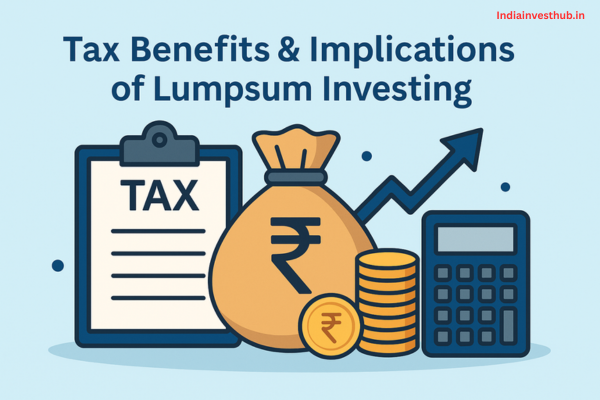
Taxation and structuring matter. For lumpsum investments in mutual funds in India:
- Equity mutual funds held for more than 12 months qualify for long-term capital gains (LTCG) tax (currently 12.5% above ₹1.25 lakh per year).
- Debt funds have a different treatment: more than 36 months => LTCG at 12.5% with indexation.
- Some schemes like PPF or sovereign bonds carry tax-free interest or special treatment. For example, PPF interest is tax-free.
- When lumping money in, always factor in exit loads, minimum holding periods and the fact that if you redeem early you may attract higher tax or suffer penalties.
For high-return ambitions using lumpsum, the tax-efficient route is to select vehicles where your horizon aligns with the long-term capital gains benefits.
Mutual Fund Taxation: Understanding How Your Investments Are Taxed
Step-by-Step Guide: How to Start a Lumpsum Investment Online
Here is a simplified process for the investor wanting to know “how to start lumpsum investment online”:
- Define your goal and horizon: e.g., grow ₹5 lakh into a retirement corpus over 15 years.
- Evaluate your risk tolerance: Are you comfortable with equity market swings or prefer stability?
- Choose the investment vehicle: e.g., a large-cap or multi-cap mutual fund suitable for lumpsum.
- Complete KYC (Know-Your-Customer) and set up a demat or mutual fund account with a trusted platform.
- Decide the amount to invest as a lumpsum. Only invest money that you can leave untouched for the horizon.
- Use a lumpsum calculator to project expected returns. Many online tools allow you to plug in amount, tenure, and expected return.
- Invest the amount. Monitor annually rather than month-to-month, since lumpsum is a long-term strategy.
- Review periodically to ensure the investment still aligns with your goal and risk profile.
Top Mistakes Beginners Make in Lumpsum Investments and How to Avoid Them:
Investors may stumble if they don’t guard against certain pitfalls:
- Mistake: Investing a lumpsum without considering the time horizon or need for liquidity.
Avoid by: Only using money you won’t need for several years. - Mistake: Ignoring the market cycle and entering at a peak impulsively.
Avoid by: Evaluating valuations or splitting into smaller chunks if unsure. - Mistake: Not diversifying—putting all into one scheme or sector.
Avoid by: Spreading across asset classes or funds. - Mistake: Failing to revisit strategy—letting bias or inertia hold you in a misfit fund.
Avoid by: Periodic review (e.g., annually) of performance and alignment with goal. - Mistake: Expecting instant results—exiting after short term because you see temporary losses.
Avoid by: Understanding lumpsum is a long-term game and short-term fluctuations are normal.
How to Calculate Expected Returns From Lumpsum Investments:
To estimate what a lumpsum could grow to, use the compound interest formula:
Future Value (FV)=P×(1+r)t
Where:
- PPP = principal (initial amount)
- rrr = rate of return (as a decimal)
- ttt = number of years
For example, if you invest ₹2,00,000 at an expected 12% annual return for 10 years:
FV=2,00,000×(1+0.12)10≈2,00,000×3.1058=₹6,21,160
Online calculators make this easier and allow you to change variables to compare scenarios. Keep in mind that “expected return” is not guaranteed—market conditions may vary.
Expert Tips to Maximize High Returns From Lumpsum Investments:
- Long horizon is essential. Many of the highest returning lumpsums enjoyed multi-year horizons, e.g., a fund turning ₹1 lakh into ₹4 crore over 30 years (CAGR ~22%).
- Match vehicle to goal. If you aim for aggressive growth, favour equity or large-mid cap funds; for moderate risk, consider hybrids or debt with some exposure.
- Monitor market valuation. While timing perfectly is impossible, being aware of extreme market euphoria or fear can guide whether you deploy full lumpsum immediately or stagger.
- Stay invested through volatility. With lumpsum, you get full market exposure from day one—resist reacting to dips if your horizon is long.
- Reinvest any dividends or coupons. This enhances compounding.
- Check fees and exit loads. High fees can erode returns.
- Use tax-efficient wrappers. Holding long enough to benefit from LTCG thresholds makes a difference.
- Have an emergency fund separate. Because your lumpsum should not be tapped for routine needs.
- Review and rebalance. Even with lumpsum, you may need to rebalance every few years to maintain asset allocation.
FAQs – Lumpsum Investment
Q1: What minimum amount constitutes “lumpsum”?
👉There is no fixed threshold; it refers more to the strategy of a one-time investment rather than periodic. Some mutual funds allow lumpsum from as low as ₹5,000.
Q2: Is lumpsum investment riskier than SIP?
👉Yes, inasmuch as you invest all your money at once and are exposed to market fluctuations from the start. SIP mitigates timing risk by spreading investments.
Q3: Can lumpsum investments be redeemed anytime?
👉Yes, generally you can redeem, subject to scheme rules, exit loads or lock-in periods if applicable.
Q4: What is the ideal horizon for lumpsum to work?
👉For “high returns” behaviour, a horizon of at least 5-10 years (and preferably longer) is more effective.
Q5: Does lumpsum always guarantee better returns?
👉No — it offers potential for higher returns but also higher risk. As one study showed, short-term lumpsum in many equity funds resulted in losses.
Conclusion:
Lumpsum investment is a powerful strategy for investors who want to know how to unlock high returns through a one-time capital deployment and are comfortable with longer horizons and striking out for growth. It demands discipline, proper vehicle selection, and patience. When used wisely—especially in a favourable growth environment with time to compound—it can outperform incremental investment approaches. But it is not without risk: market timing, valuation entry and emotional survival matter.
If you are ready to deploy a significant amount, commit it for the long term, and align with the right investment vehicle and tax structure, lumpsum investment can be your pathway to higher returns—but are you prepared to take that leap?