
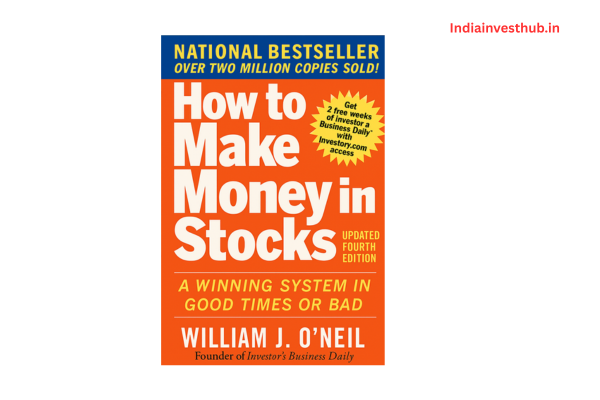
It was a hot summer afternoon when I visited a small local café and overheard a seasoned investor whisper, “I found the breakthrough in my trading when I understood one book.” That sparked my curiosity, and the book in question turned out to be How to Make Money in Stocks: A Winning System in Good Times or Bad by William J. O’Neil. If you, the reader, are looking to understand whether this book is worth your time and how it might help you make smarter moves in the market, then you’re in the right place.
At IndiaInvestHub, we sift through the details so you don’t have to—let’s dive into how the CAN SLIM system can serve you, where it shines, and where it falls short.
About the Author: Who Is William J. O’Neil?
William J. O’Neil is a veteran of the stock market, founder of Investor’s Business Daily (IBD) and the author of this influential investing guide. He built his approach on a deep study of the market’s top-performing stocks and distilled it into his CAN SLIM strategy. O’Neil’s background gives him credibility: he did the research, he sees patterns in both fundamental and technical dimensions, and he has packaged them into a readable resource for investors.
🔗Buy on Amazon
Price Range in India: ₹526 – ₹726
Core Concept: Understanding the CAN SLIM Strategy

The heart of the book lies in O’Neil’s acronym: C A N S L I M. Each letter corresponds to a trait to look for in a stock:
- C = Current quarterly earnings growth
- A = Annual earnings growth
- N = New product, service, management or high (innovation)
- S = Supply and demand (volume, institutional interest)
- L = Leader (industry-leading stock)
- I = Institutional sponsorship (funds, big investors buying)
- M = Market direction (overall market trend)
According to the strategy’s outline, by finding stocks that satisfy these criteria and buying them as they’re emerging from a consolidation or base breakout, you increase your odds of catching big winners.
For example, the “C” – current earnings – is treated as a threshold that many of the greatest stocks crossed before their major run-ups. The “M” or market direction reminds you that even a great stock can struggle if the overall market is weak.
Key Lessons from the Book
From our review for readers like you, here are some of the standout lessons:
- Look for stocks with strong recent and annual earnings growth. O’Neil recommends a minimum threshold (some analysts cite at least ~20–25% growth in recent earnings) to filter out weak companies.
- Don’t just buy any breakout — buy after the consolidation, when volume picks up and the stock is showing momentum.
- Use charts (technical patterns) as confirmation, not just fundamentals. The book emphasizes reading base formations, cup-with-handle patterns, and volume expansion.
- Manage risk: O’Neil stresses the importance of cutting losses and letting winners run, rather than holding onto dead-weight stocks.
- The environment matters: Recognize the market trend and avoid fighting it. Even the best stock can be hampered in a weak market.
Why Chart Patterns Matter: Technical Meets Fundamental

One of the unique features of How to Make Money in Stocks is its combination of fundamental screening (earnings growth, leadership, etc.) with technical chart reading. According to the summary, “You should learn stock chart patterns, and one pattern especially.” The “cup with handle” is often highlighted as a classic setup: after a strong run, the stock consolidates into a curved “cup,” forms a smaller “handle,” and then breaks out.
By integrating both sides, O’Neil argues you can increase your odds of timing a trade well: the fundamentals hint at a strong company, and the chart suggests Institutional/market recognition is underway. That crossover of supply-demand and fundamentals is a core differentiator. As an investor reading for review, you’ll want to pay attention to both — not just one or the other.
Psychology of Investing: Mastering Emotions in the Market
One of the recurring themes in the book—and in our review—is emotional discipline. The book warns of common pitfalls: ignoring the overall market, holding onto losing stocks expecting they’ll recover, or jumping into a breakout that lacks strength. Reddit contributors point out that the book has a lot of wisdom but some of the writing may lead inexperienced investors astray if they skip nuance.
Real-World Application: How to Use CAN SLIM Today
So how do you apply the book’s concepts in practice? Here’s a simplified step-by-step,
- Screen for stocks with strong recent quarterly and annual earnings growth (C & A).
- Check for “new” factors: new product, new high, or new leadership (N).
- Evaluate supply/demand: shares outstanding, recent institutional buying (S & I).
- Confirm it’s a leader in its sector (L). Avoid laggards.
- Check the overall market trend (M) — if the market is weak, reduce exposure or wait.
- Use chart patterns: identify a base, ensure volume is increasing, look for a breakout.
- Once you enter, follow rules for stop-loss and let winners run, manage risk diligently.
The book may have been written originally for the U.S. market, but the principles are adaptable globally—including emerging markets like India. While you adapt to local conditions (different indices, sector rotations, currency risk), the underlying logic holds.
Pros:
- The book gives a clearly defined framework (CAN SLIM) — very useful for structured investors.
- Combines technical and fundamental analysis, which many books separate.
- Provides real-world examples and case-studies of winning stocks.
- Suitable for both beginners and those with some experience—especially for growth-stock focus.
Cons:
- Some readers feel it places heavy emphasis on chart patterns and “lead stocks” which may be harder to find in certain markets.
- The strategy may require attentiveness and discipline—not passive. You can’t just buy and forget.
- Timing is critical; in strong down-markets the approach may underperform or require adjustment. The “M” factor is often underrated by some readers.
- Some aspects (especially sales of the breakout model) may appear promotional or simplified for novices.
Top 10 Technical Analysis Books Every Trader and Investor Should Read
Comparison with Other Investment Classics
When comparing How to Make Money in Stocks with other investing books:
- Unlike value-investing classics like The Intelligent Investor by Benjamin Graham (which emphasise margin of safety and long-term holds), O’Neil’s book is more growth and momentum-oriented.
- Unlike books that purely focus on technical patterns or trading systems, this combines fundamentals and charts.
- If you’ve read something like One Up on Wall Street by Peter Lynch (which is more anecdotal and qualitative), O’Neil’s book is more systematic.
So if you prefer a structured method to pick growth stocks, O’Neil’s book offers that. If you prefer value investing or purely long-term buy-and-hold, you might blend O’Neil’s concepts with other approaches.
Who Should Read This Book?
This book is ideal for:
- Investors who want a system rather than just anecdotes.
- Those interested in growth stocks rather than purely value stocks.
- People willing to actively monitor charts, volume, market trends and fundamentals.
- Intermediate investors who already have a basic understanding of stocks and are ready to add a disciplined approach.
- It might be less ideal for:
- Investors who want a passive buy-and-forget-style approach.
- Those who are only interested in value stocks with no momentum element.
- Investors who do not have time to monitor markets or charts.
Best Books to Learn Fundamental Analysis
FAQs – How to Make Money in Stocks by William J. O’Neil
Q1: Is this book only for U.S. markets?
👉While the examples are largely U.S.-centric, the underlying principles (earnings growth, supply/demand, base breakouts) apply globally. With some adaptation, you can use the ideas for Indian or other markets.
Q2: Do I need to be an expert trader to use this book?
👉No — the book is accessible to beginners, but to gain full benefit, you’ll need discipline and willingness to apply the rules.
Q3: Will following this guarantee I make money?
👉No investing strategy can guarantee profits. Past performance is not indicative of future results. The book emphasises risk management (cutting losses) and following a process.
Q4: How long does it take to see results?
👉It depends. Some breakout stocks can move fast, but consistent results usually come from applying the method over time, tracking trades, learning from mistakes and sticking with discipline.
Q5: Is this book better than other investing books?
👉It depends on your style. If you like growth/invest-and-monitor systems, it’s among the best. If you prefer passive index-investing or value-only strategies, you might pair it with another book.
Conclusion:
So, Which Book Should You Choose?
- If you are looking for a structured, growth-stock-momentum system with clear rules → go for How to Make Money in Stocks by William J. O’Neil.
- If you lean toward passive investing, long-term value and minimal monitoring → consider a classic like The Intelligent Investor.
- If you invest in emerging markets (like India) and want to adapt global methods locally, use How to Make Money in Stocks and complement it with local-market research.
- If you have time to actively research, monitor and trade based on charts and momentum → O’Neil’s method suits you. If not, a simpler buy-and-hold strategy might be more practical.
Which path fits your investing style and goals?


