
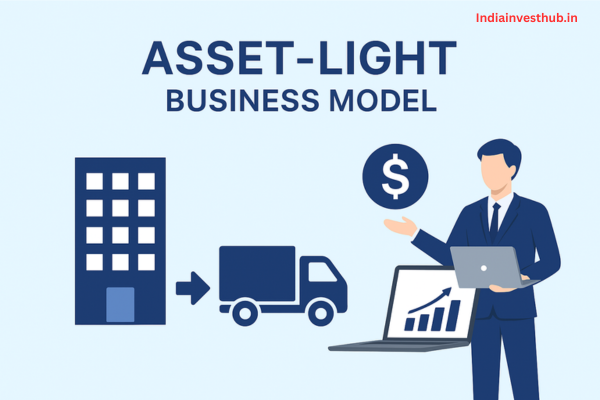
Imagine two entrepreneurs, Priya and Sameer, launching startups in India. Priya builds a logistics company owning a fleet of trucks, warehouses, and expensive real estate. Sameer launches a platform that connects shippers with third-party transport providers without owning trucks. When business slows, Priya is stuck with fixed costs she can’t reduce; Sameer pivots, shrinks, or scales quickly. That contrast is at the heart of the Asset-Light Business Model.
At Indiainvesthub, we help readers and entrepreneurs like you understand What Is the Asset-Light Business Model, whether it suits your venture, and how to adopt it smartly. In this article, you’ll get a solid foundation—Introduction to the Asset-Light Business Model, Key Characteristics, real Examples, revenue mechanics, Advantages and Challenges, a comparison with Asset-Heavy models, and ideal Industries where it works best.
1. Introduction to the Asset-Light Business Model

An asset-light business model is one where a company deliberately minimizes ownership of physical, capital-intensive assets, and instead focuses on leveraging partnerships, outsourcing, networks, technology, and intangible assets.
Rather than building factories or owning fleets, an asset-light business concentrates on the value it adds (platform, brand, algorithms, service) and delegates non-core aspects to external providers. This model is increasingly adopted as companies aim to reduce capital lock-in and increase flexibility.
A study of 2,687 large firms across 24 industries found that, on average, more asset-light companies earned better return on assets than their heavier counterparts. Also, in the last five years, asset-light firms outperformed their peers in total shareholder return by about 4 percentage points.
2. Key Characteristics
Here are the hallmarks of an asset-light business:
- Minimal physical assets: Low investment in land, machinery, inventory, warehouses.
- Outsourcing and partnerships for non-core tasks (manufacturing, logistics, facility management).
- Intangible assets focus: Brand, software, algorithms, customer relationships, data.
- Variable cost structure: More costs scale with activity, fewer fixed overheads.
- Scalability and flexibility: Easy to enter new markets or scale up with lower incremental capital requirement.
- Control via governance, not ownership: Instead of owning, you structure contracts, incentives, and performance monitoring.
3. Examples
- Uber / Lyft: They don’t own cars; they connect drivers (asset owners) to riders, taking a commission.
- Airbnb: They don’t own hotel properties—they enable homeowners to list spaces and take a cut.
- Hyatt (hotel industry): In its “asset-light” approach, Hyatt has sold off many real estate assets and shifted toward franchising and management contracts; it claims over 80% of its operations are now asset-light.
- WeWork (co-working space), Apple (outsourcing manufacturing) are also cited examples of leveraging asset-light principles.
4. How Asset-Light Models Generate Revenue
- Platform / Commission / Fee: You act as a facilitator, taking a percentage of each transaction (e.g. Uber, Airbnb).
- Service contracts / management fees: You manage or operate assets you don’t own for a fee (e.g. hotel management).
- Subscription / SaaS: You provide software or tools (intangible) and charge recurring fees.
- Licensing / franchising: Others operate under your brand/technology and pay royalties.
- Value-added services: Upsells, data analytics, premium services on top of the core offering.
Because costs are more variable and capital tied up is lower, margins (on invested capital) can be attractive.
5. Advantages
- Lower capital requirements / less capital lock-in: You don’t tie up large funds in assets.
- Higher return on assets / better utilization: Since fewer assets are owned, returns per asset tend to be higher.
- Scalability & agility: You can grow fast across geographies or lines without heavy investments.
- Lower fixed cost risk / less exposure to depreciation: Fixed overheads are lower, less burden from asset depreciation.
- Focus on core competence: You focus on what you do best (brand, platform, technology) and outsource the rest.
- Better adaptability to market changes: Less inertia from physical footprints.
6. Challenges and Risks
- Reliance on third parties / partners: If a key vendor fails, your business is impacted.
- Control & quality risk: Without direct ownership, maintaining standards is harder.
- Margin pressure on partner fees: Outsourcing partners take a share.
- Brand dilution / misalignment: Partner actions can damage the customer experience.
- Complex coordination / governance: You need strong contracts, monitoring, incentives.
- Industry constraints: Some businesses need physical control (e.g. heavy manufacturing).
- Financial risk around variable costs in low demand periods: If volume drops, margins can shrink more sharply.
Difference Between Asset-Light Business and Asset-Heavy Business
7. Asset-Light vs Asset-Heavy: Comparison Table
Feature | Asset-Light Model | Asset-Heavy Model |
|---|---|---|
Image |  |  |
Capital investment | Low / moderate | Very high |
Fixed costs | Low | High |
Scalability | Easier | Slower, constrained by assets |
Control over operations | Through contracts & governance | Direct control |
Risk from asset depreciation | Minimal | Significant |
Return on assets | Potentially higher | Lower, due to heavy assets |
Barrier to entry | Lower | Higher |
Flexibility / agility | High | Lower |
Ideal in volatile demand | Better | Risky |
Dependence on partners | High | Lower |
Asset-Heavy Business Model
8. Industries Where Asset-Light Models Work Best
The asset-light approach tends to shine in industries where technology, platforms, networks, or services play a central role. Some ideal domains:
- Technology / Software / SaaS
- Marketplace & Platform businesses (e.g. ride sharing, delivery, peer-to-peer)
- Hospitality / lodging (via franchising, management contracts rather than owning hotels)
- Fintech / digital financial services (low branch network, digital infrastructure)
- Media / content / streaming
- Consulting / services / outsourcing
- E-commerce / logistics (outsourced fulfillment)
- Energy or utilities (via decentralized or partner models)
However, in heavy industries (steel, chemical processing, mining) the model may be harder to apply because owning assets is critical to operations.
FAQs – Asset-Light Business Model
Q1: What is the Asset-Light Business Model?
👉The Asset-Light Business Model is a strategy where a company minimizes ownership of physical or capital-intensive assets and focuses instead on technology, brand, or partnerships to generate revenue efficiently.
Q2: Why are companies shifting to an asset-light approach?
👉Businesses are moving toward asset-light models to improve flexibility, scalability, and return on assets. It allows them to respond faster to market changes while reducing heavy capital investments.
Q3: Which industries commonly use the asset-light model?
👉Industries like hospitality, technology, SaaS, ride-sharing, e-commerce, consulting, and financial services frequently use asset-light strategies due to their service or platform-based structures.
Q4: What are some examples of asset-light companies?
👉Uber, Airbnb, Apple, and Hyatt are great examples. These companies operate platforms or services without owning most of the underlying physical assets, such as vehicles, factories, or hotels.
Q5: How does an asset-light company make money?
👉Asset-light firms earn through commissions, licensing, management fees, or subscriptions instead of direct production or ownership of assets.
Conclusion:
Asset-Light Business Model offers a compelling route for modern ventures: lower capital commitment, greater flexibility, scalability, and the ability to focus on core strengths. But it also demands strong coordination, quality control, and risk management when relying on external partners. Not all industries or businesses can go fully light—but many can benefit from hybrid strategies.
If you’re curious how this model maps to your own idea or firm, would you like me to map out an asset-light feasibility plan for your business?


