
Stock Buybacks are a financial tool companies use more than ever before — and they matter a lot if you’re an investor trying to figure out where your returns come from. In 2024, U.S. corporations returned $1.6 trillion to shareholders, and about 60% of that was through stock buybacks rather than dividends, underlining how central buybacks have become in corporate finance.
For many investors, buyback announcements are exciting — but they can also be confusing. Why exactly do companies repurchase shares? How does it change earnings or share prices? And importantly: what does all of this mean for your portfolio? This article breaks it down in a way that helps you make better choices, not just react to headlines.
What Is a Stock Buyback?
At its simplest, a stock buyback happens when a company uses its own cash to repurchase shares from the open market or directly from shareholders. The goal is to reduce the number of shares available publicly — so each remaining share represents a slightly bigger slice of ownership.
Unlike dividends, which send cash directly into investors’ pockets, buybacks indirectly benefit shareholders by concentrating earnings and potentially lifting stock prices. Think of buybacks as a company saying, “We believe our shares are worth more than what the market says today.”
Why Companies Repurchase Their Shares: Key Business Reasons
Companies don’t buy back shares for fun. Here are the major reasons you’ll see buybacks announced:
1. Signaling Confidence
When a company repurchases its shares, management often wants investors to know that they believe the shares are undervalued. This can create positive momentum in stock price as market sentiment shifts.
2. Boosting Financial Metrics
A buyback reduces the share count — and that has measurable effects on key ratios like EPS (earnings per share). This can make financial performance look stronger even if the business hasn’t grown earnings.
3. Returning Cash to Shareholders
Some companies have more cash than they know what to do with. Instead of reinvesting in low-return projects, they return cash via buybacks. This can be especially attractive when dividend tax rates are higher than capital gains tax rates.
4. Reducing Dilution
Stock options and employee compensation can increase the number of shares over time. Buybacks help neutralize that dilution.
Each of these reasons carries implications for your portfolio — which we’ll examine next.
How Stock Buybacks Affect Share Price and Market Sentiment:
Buybacks often deliver short-term share price uplift. That’s not magic — it’s supply and demand. With fewer shares available, existing shares can become scarcer, and if demand stays the same, price tends to rise.
Studies show this in the data too: research examining share buyback announcements across companies found a cumulative average abnormal return (CAAR) of about +3.96% around the event window, suggesting a modest price boost linked to buyback announcements.
However, not all buybacks produce gains. Some academic studies from India show mixed effects, where certain buyback announcements didn’t significantly move share prices — reminding investors that execution and context matter.
Impact of Buybacks on Earnings Per Share (EPS) and Valuation:
Here’s a crucial point for investors: buybacks mechanically increase EPS without increasing actual profits — because the denominator (number of outstanding shares) gets smaller. For example, if a company with $100 million in earnings buys back enough stock to reduce shares from 10 million to 8 million, EPS jumps — even though earnings haven’t grown.
That’s why many analysts caution that rising EPS from buybacks isn’t the same as real growth from better business performance.
In terms of valuation:
- Higher EPS can lead to a lower P/E ratio if the price doesn’t rise as fast, tempting investors to think the stock is cheaper.
- But if the price rises to match the EPS bump, the P/E stays the same.
Understanding this helps you separate accounting effects from real economic value.
Stock Buybacks vs Dividends: Which Is Better for Your Portfolio?
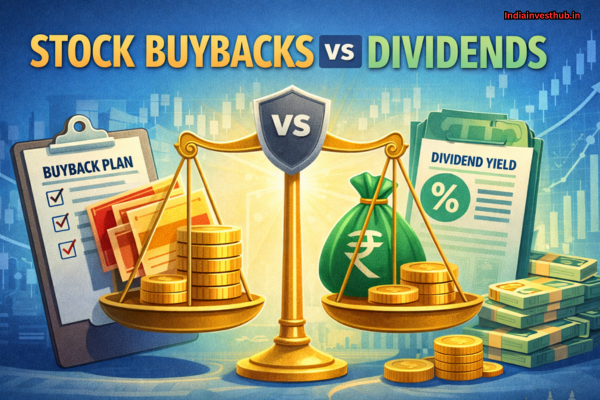
Many investors ask whether buybacks are preferable to dividends — and the answer depends on your goals.
Dividends
- Direct income
- Predictable cash for investors
- Often taxed in the year received
Buybacks
- Can boost share price and EPS
- Often more tax-efficient if gains are long-term
- No guaranteed cash unless you sell
Buybacks tend to be more flexible for companies and potentially more tax-friendly for shareholders — but they don’t provide guaranteed income.
For portfolios focused on income, dividends may be preferable. For total return strategies where taxes and long-term gains matter, buybacks can be compelling.
When Buybacks Create Value — And When They Destroy It:
✅ Buybacks Can Create Value When:
- Shares are genuinely undervalued
- The company has no better investment opportunities
- The buyback is funded with excess cash (not debt)
- Long-term growth prospects justify price support
⚠️ Buybacks May Destroy Value When:
- A company borrows heavily to repurchase shares
- Shares are bought at peak valuation
- Management uses buybacks to mask weak performance
- The purchase delays critical business investments
In short, quality matters. Timing matters. Buybacks done right can help your portfolio; buybacks done poorly can shrink future returns.
Buybacks During Market Highs vs Lows: What Investors Should Watch
Buybacks during market downturns often happen at lower share prices — potentially giving existing shareholders a better deal. That’s because the company is buying more shares for the same amount of cash.
In contrast, buybacks at market highs can seem expensive and may suggest that management is chasing valuation rather than creating shareholder value.
From investor research, buybacks during high price levels sometimes lead to muted post-announcement performance compared to buybacks at lower valuations. This is something careful investors should watch when analyzing quarterly reports.
How to Analyze a Company’s Buyback Program Before Investing:
Here are practical criteria you can use:
- Buyback Size vs Market Cap – A 5% buyback means something very different than 20%. (See examples like Coal India or Tips Music in India.)
- Funding Source – Is the buyback funded from excess cash or debt?
- EPS Trend – Is EPS rising primarily due to buybacks or real growth?
- Management Rationale – Did the company explain a strategic reason?
- Price History – How has the stock performed before and after previous buybacks?
A company that combines strong fundamentals with disciplined, well-timed buybacks is generally a healthier investment than one that uses buybacks to artificially inflate metrics.
Tax Implications of Stock Buybacks for Individual Investors:
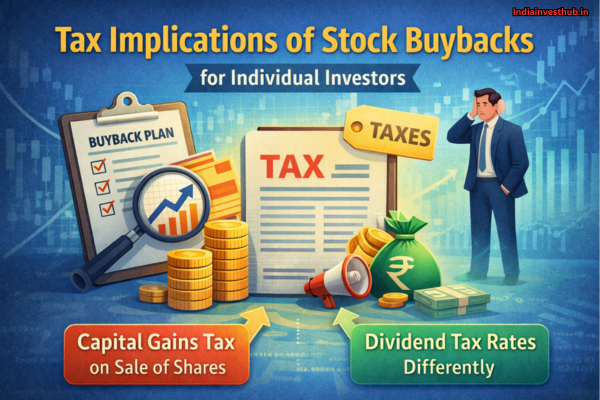
From a taxation perspective:
- In many countries, capital gains taxes apply when you sell shares after a price increase due to a buyback.
- Dividends may be taxed differently (often at higher marginal rates).
- Buybacks do not result in taxable events unless you sell — meaning investors can defer tax by waiting until they sell shares.
In India, buybacks are governed by specific regulations under SEBI and the Companies Act, with tailored disclosure and reporting requirements that ensure transparency for investors.
Buybacks in the Indian Stock Market: Rules, Trends, and SEBI Guidelines
In India, buybacks must comply with SEBI’s regulatory framework under the SEBI (Buy-back of Securities) Regulations, 2018.
Companies can repurchase shares:
- Through a tender offer
- On the open market
- (Historically) through odd-lot offers
Between FY 2018 and FY 2022, 151 companies used the tender offer route and 66 used the open market route — showing that Indian firms are actively using buybacks.
Indian buybacks are often well received by markets — in some studies, average abnormal returns on announcement day were around +2.07%, indicating positive investor reaction.
Notable buybacks like Infosys’ ₹18,000 crore repurchase at a 19% premium show Indian companies using buybacks strategically to signal confidence and reward shareholders.
Common Myths About Stock Buybacks That Investors Should Ignore:
Myth #1: Buybacks Always Boost Long-Term Returns
Reality: Buybacks can help, but they can also mask weak performance or misallocate capital.
Myth #2: Bigger Buybacks Are Always Better
No — size doesn’t always reflect value creation.
Myth #3: Buybacks Mean Management Is Always Confident
Sometimes buybacks are used to manage earnings, not create value. — knowing these distinctions keeps you from overvaluing stock moves.
FAQs – Stock Buybacks
Q1: Do buybacks guarantee higher stock prices?
👉No. They often correlate with price gains, but context matters.
Q2: Should I sell during a buyback?
👉Only if it aligns with your investment strategy — sometimes holding longer yields greater total return.
Q3: Are buybacks more tax-efficient than dividends?
👉Often, yes, because you may defer taxes until you sell.
Q4: Can small investors participate directly?
👉In tender offers specific to public shareholders, yes — though participation terms vary.
Conclusion:
Stock Buybacks are a powerful corporate tool that can influence your portfolio — from improving earnings per share and sending confidence signals to affecting share prices and tax outcomes. But like any tool, their impact depends on how thoughtfully and strategically they’re deployed by companies. For investors who want to know Understanding Stock Buybacks: How They Impact Your Portfolio, the key is not just recognizing what buybacks are, but learning how to analyze them, when to trust them, and how they fit with your personal investment goals.
With buyback volumes hitting record levels globally and Indian companies increasingly adopting them within SEBI’s regulatory framework, the question every investor should ask themselves is:
Are you ready to use buybacks as a strategic lens in building your long-term portfolio?


